LinkedIn has become one of the most valuable platforms for professional networking, personal branding, and business development. Entrepreneurs, marketers, consultants, sales professionals, and business owners use it to connect with potential customers, build relationships, and discover new opportunities. However, there is one common challenge that many professionals face: having plenty of LinkedIn connections but very few actual leads.
The truth is that LinkedIn connections don't become leads automatically. Accepting a connection request is only the beginning of a professional relationship. It does not necessarily mean that someone is interested in your services, ready to purchase, or looking for a business solution.
Successful LinkedIn marketing requires more than growing your network. It involves understanding your audience, building trust, sharing relevant content, starting meaningful conversations, and guiding potential customers toward the next step. If your LinkedIn network continues to grow but your enquiries and conversions remain low, understanding the reasons behind this gap can help you improve your lead generation strategy.
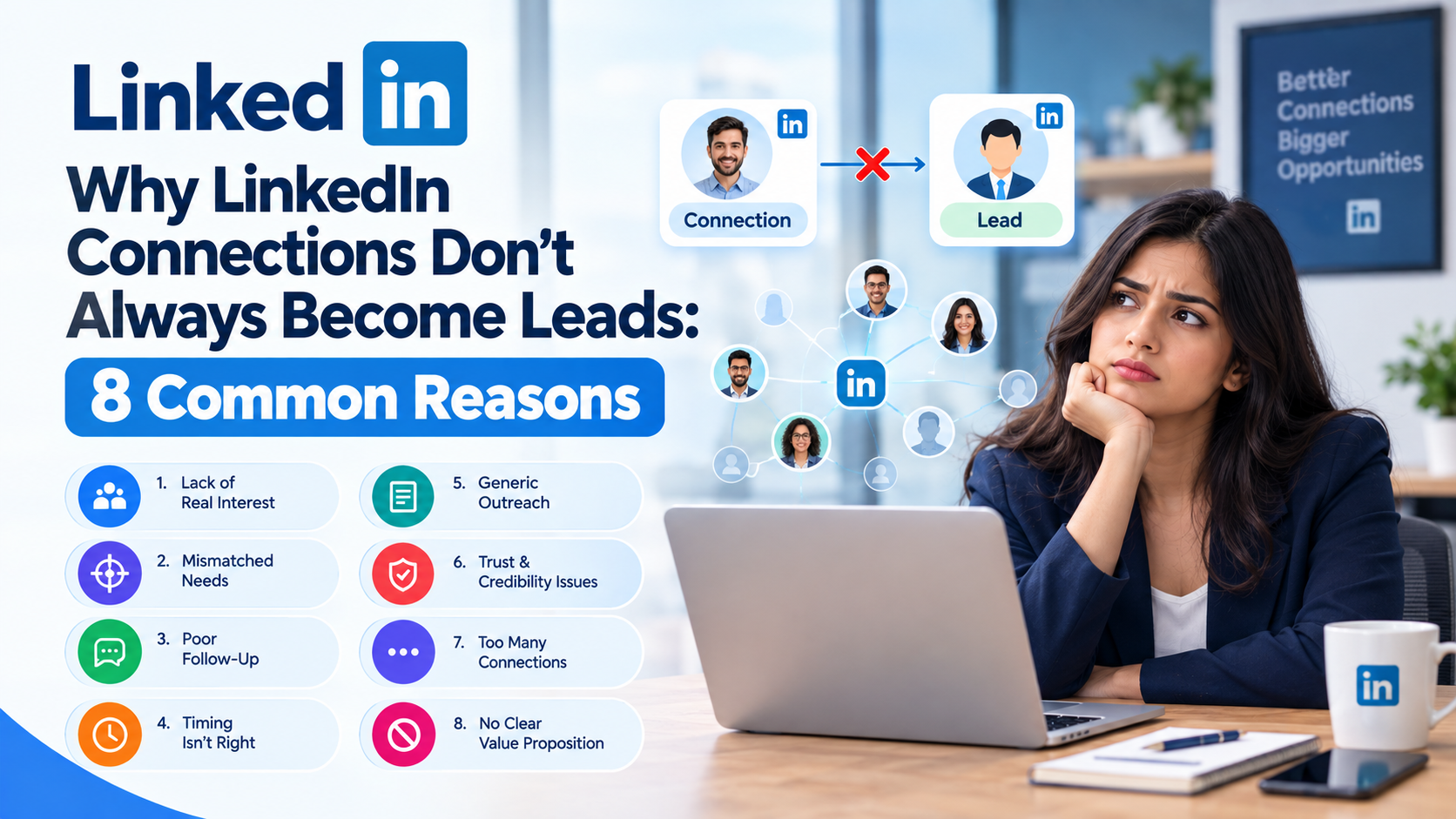
1. You Are Connecting With the Wrong Audience
One of the biggest reasons LinkedIn connections don't become leads is that professionals focus on the number of connections rather than their relevance. A large network may look impressive, but it will not generate consistent business opportunities if most of those people are unlikely to need your products or services.
For example, a digital marketing agency that wants to attract small-business clients may gain limited results by connecting primarily with students, job seekers, or professionals outside its target market. These connections may be valuable for networking, but they may not have the purchasing authority or immediate need for the agency's services.
The solution is to define your ideal customer profile before sending connection requests. Consider factors such as industry, job title, company size, location, business challenges, and decision-making authority. Use LinkedIn's search tools to identify founders, marketing managers, business owners, or other relevant professionals who are more likely to benefit from your offering.
A smaller network of relevant decision-makers can be more valuable than thousands of unrelated connections.
2. Your Connection Requests Lack Personalization
Generic connection requests often fail to create a meaningful first impression. When people receive multiple invitations from professionals they do not know, they may ignore messages that provide no clear reason to connect.
A personalized connection request demonstrates that you have taken the time to understand the other person's professional background. Mentioning a recent post, a shared industry interest, a professional achievement, or a common connection can make your invitation feel more genuine.
For instance, instead of sending a generic request, you could write: "Hi Rahul, I came across your posts about business growth and found your insights interesting. I'd be happy to connect and follow your work."
This approach establishes a natural starting point for future communication. The objective is not to sell immediately but to create a relevant professional connection that can develop over time.
3. You Try to Sell Too Early
Another common mistake is treating every new LinkedIn connection as an immediate sales opportunity. Some professionals send a connection request and follow it with a long promotional message, a service brochure, or a meeting request before establishing any relationship.
This approach can make the interaction feel transactional. The recipient may not understand your value, trust your expertise, or have a current need for your services. Even if your offering is useful, an immediate sales pitch can reduce the likelihood of a response.
Instead, focus on building familiarity before introducing your services. Start with a friendly message, engage with relevant content, ask thoughtful questions, or share a useful resource related to the person's industry.
Once a genuine conversation develops and a relevant business challenge becomes clear, you can introduce your solution naturally. Selling becomes more effective when it follows an understanding of the customer's needs rather than preceding it.
4. Your LinkedIn Profile Does Not Communicate Your Value
Your LinkedIn profile often acts as the first credibility check after someone receives your connection request. If your profile does not clearly explain what you do, whom you help, and what value you provide, potential customers may hesitate to continue the conversation.
A profile that contains only a job title and a list of responsibilities may not communicate why someone should work with you. Prospects need to understand how your experience relates to their challenges and what makes your approach useful.
Improve your headline by explaining your expertise and the audience you serve. Use the About section to describe the problems you help solve, the services you provide, and the outcomes you aim to deliver. Include relevant projects, case studies, client feedback where available, and examples of your work.
For example, instead of writing only "Digital Marketer," you could use a more specific headline such as "Helping Small Businesses Improve Lead Generation Through SEO and LinkedIn Marketing."
Your profile should answer one important question: why should the right person trust you enough to start a conversation?
5. You Are Not Sharing Content That Builds Trust
People may connect with you without immediately needing your services. They might be researching their options, learning about an industry, or simply expanding their professional network. Relevant content can keep you visible and demonstrate your expertise when they eventually need a solution.
If your LinkedIn activity consists only of promotional posts, service announcements, or direct sales messages, your audience may have little reason to engage with your content.
A stronger content strategy balances education, practical advice, professional experiences, and service-related information. Share common industry challenges, explain how to solve specific problems, discuss lessons learned from projects, and offer actionable recommendations.
For example, a marketing consultant could publish a post explaining why websites attract traffic but fail to generate enquiries. A CRM specialist could discuss how businesses lose leads through poor follow-up processes.
This type of content demonstrates an understanding of real business problems. Over time, consistent and useful publishing can help connections recognize your expertise and remember you when a relevant need arises.
6. You Do Not Follow Up Consistently
Not every potential customer will respond to your first message. People are busy, messages get overlooked, and business priorities change. A lack of response does not always mean a person has no interest in your offering.
However, many professionals either stop communicating after one unanswered message or follow up repeatedly with messages that simply ask whether the recipient is ready to buy.
An effective follow-up should provide context or value. You could share a relevant article, offer a useful observation, ask a thoughtful question, or refer to something the person previously discussed.
For example, if you connected with a business owner who mentioned difficulties generating enquiries, you might follow up with a practical suggestion or a resource related to lead conversion.
Keep follow-ups professional, relevant, and respectful. If someone does not respond after a reasonable number of attempts, give them space rather than continuing to send messages. The objective is to create an opportunity for conversation, not to pressure the recipient.
7. Your Messaging Does Not Address Customer Problems
Potential customers are generally more interested in solving their business problems than learning about every feature of your service. Messages that focus entirely on your company, your achievements, or your service packages may fail to communicate why the recipient should care.
Consider the difference between saying, "We provide SEO, social media marketing, website development, and CRM services," and explaining, "If your website attracts visitors but generates few enquiries, improving landing-page messaging and follow-up processes may help you convert more of that traffic."
The second message focuses on a recognizable business challenge and suggests a possible direction for solving it.
Before contacting a connection, research their business and consider the problems they may be facing. Avoid assuming that every prospect has the same needs. Ask relevant questions, listen to their responses, and present your services only when there is a reasonable fit.
When your communication connects a specific problem with a useful solution, it becomes easier for potential customers to understand the value of continuing the conversation.
8. You Do Not Have a Clear Conversion Process
Even when LinkedIn conversations generate interest, leads can disappear if there is no clear next step. A person might respond positively to your message but never schedule a meeting because the conversation remains vague or the process requires too much effort.
Effective lead generation needs a simple path from initial connection to meaningful business discussion. This process may include connecting with relevant professionals, engaging with their content, starting a conversation, identifying their needs, and offering an appropriate next step.
Depending on the situation, that next step might be a short discovery call, a demonstration, a consultation, a relevant case study, or a request for permission to share more information.
It is also important to track conversations and follow-ups. A simple CRM or spreadsheet can help you record the prospect's name, company, business need, last interaction, next follow-up date, and current status.
By managing your pipeline systematically, you can reduce missed opportunities and understand where potential customers are dropping out of the process.
How to Turn LinkedIn Connections Into Business Leads
Converting professional connections into leads requires a consistent strategy rather than a single message. Start by identifying the audience most likely to benefit from your services. Improve your profile so that visitors immediately understand your expertise and value proposition.
Next, build relationships through personalized communication and useful content. Engage with your connections' posts when you have something meaningful to contribute, and avoid sending sales pitches without understanding their needs. When a conversation reveals a relevant challenge, explain how you might help and suggest a simple next step.
Finally, measure the results of your activities. Track how many relevant people you connect with, how many accept your requests, how many respond to messages, how many conversations qualify as potential opportunities, and how many become paying customers.
These measurements help you identify whether your biggest challenge is audience targeting, engagement, messaging, follow-up, or conversion. Instead of focusing only on growing your connection count, use these insights to improve the quality of your business relationships.
Conclusion
LinkedIn connections don't always become leads because networking and customer acquisition are two different processes. A connection creates access to another professional, but a lead usually requires a relevant business need, trust, meaningful communication, and a clear path toward a potential solution.
The most effective LinkedIn marketing strategy focuses on relationship quality rather than connection quantity. Connect with the right audience, personalize your communication, share helpful content, follow up respectfully, and make it easy for interested prospects to take the next step.
Remember that not every connection will become a customer, and that is normal. The goal is to identify the people who genuinely need what you offer and build relationships that can develop into valuable business opportunities over time.
When you approach LinkedIn as a relationship-building platform rather than simply a sales channel, you can create a stronger foundation for sustainable lead generation and long-term business growth.