Introduction
Artificial intelligence is rapidly changing the way websites and web applications are designed, developed, tested, and maintained. What once required developers to spend hours writing repetitive code, analyzing user behavior, testing different interfaces, and troubleshooting errors can now be supported by intelligent AI-powered tools. AI is not replacing the need for web developers; instead, it is becoming a powerful assistant that helps developers work more efficiently and focus on solving complex problems.
Modern businesses are also expecting more from their websites. A website is no longer simply an online brochure. Users expect fast loading times, personalized experiences, intelligent search, responsive designs, instant customer support, and smooth interactions across different devices. AI is helping developers meet these expectations by bringing automation and intelligence into different stages of the web development process.
AI-Assisted Coding
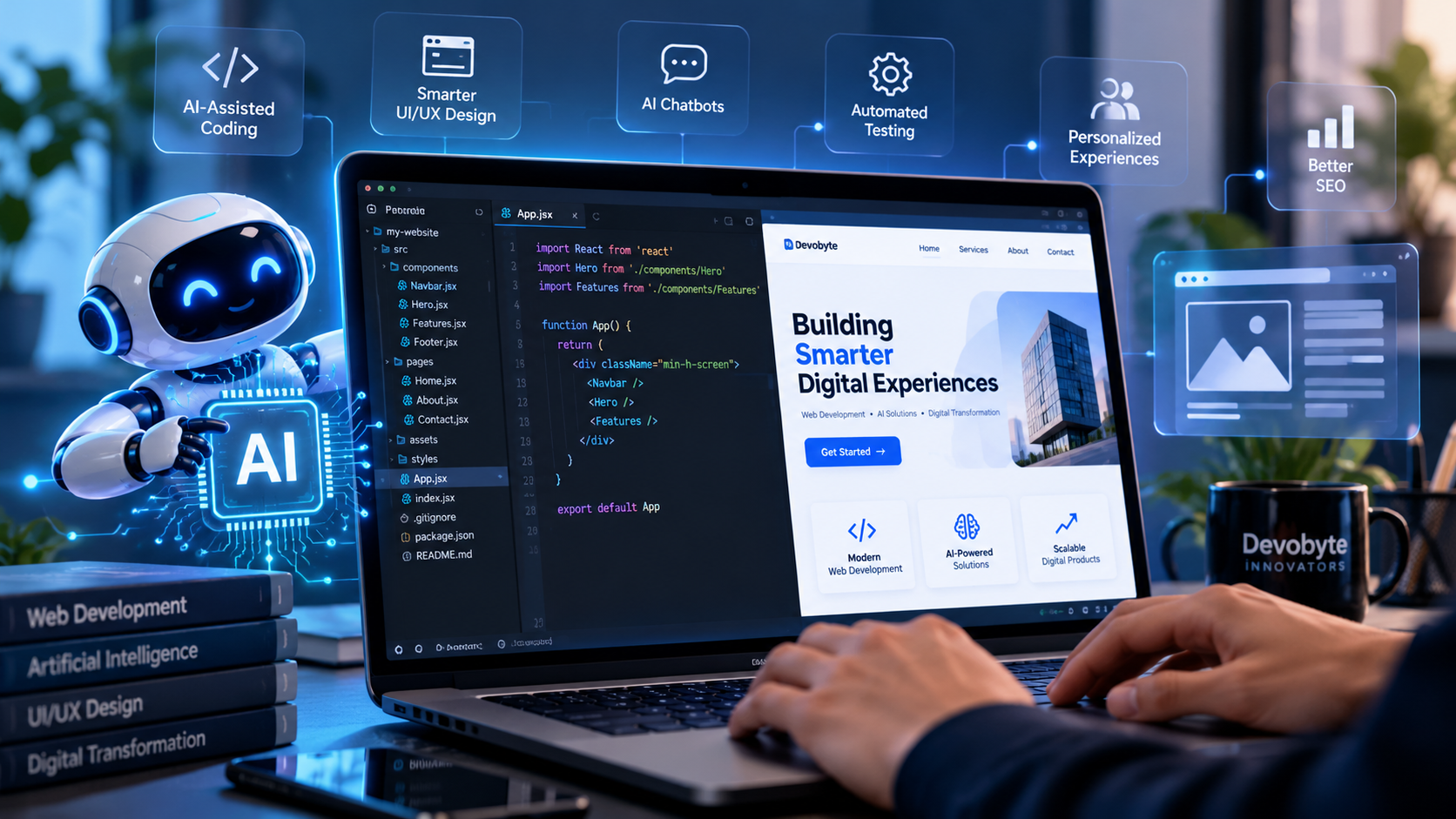
One of the most noticeable changes brought by AI is the way developers write code. AI-powered coding assistants can generate code based on natural-language instructions, suggest functions, complete repetitive sections, explain unfamiliar code, and help developers identify potential errors. This can significantly reduce the time spent on routine programming tasks.
For example, instead of manually creating the basic structure of a webpage, a developer can describe the required layout and functionality and use AI to generate an initial version of the code. The developer can then review, modify, test, and improve that code according to the project's requirements. This approach allows developers to spend more time thinking about architecture, functionality, security, and user experience rather than repeatedly writing boilerplate code.
However, AI-generated code still needs human supervision. Developers must verify whether the code is correct, secure, efficient, and suitable for the specific application. AI should therefore be viewed as a development assistant rather than a replacement for programming knowledge.
AI for UI and UX Design
User experience plays an important role in determining whether visitors stay on a website or leave it. AI is helping designers and developers create interfaces that are more intuitive and responsive to user needs.
AI tools can assist with generating design concepts, organizing layouts, suggesting interface elements, and analyzing how users interact with a website. Developers can use these insights to improve navigation, simplify complicated interfaces, and create more user-friendly experiences.
AI can also help create personalized interfaces. For example, an e-commerce website may display product recommendations based on a customer's previous interactions. Similarly, a content platform can recommend articles or videos based on a user's interests. These experiences make websites feel more relevant to individual users.
AI-Powered Chatbots and Virtual Assistants
AI-powered chatbots have become a common feature on modern websites. Traditional chatbots often relied on predefined questions and answers, while modern AI chatbots can understand natural-language questions and provide more flexible responses.
Businesses can use these systems to answer frequently asked questions, provide product information, guide users through services, collect basic information, and assist customers outside normal business hours. This can reduce the workload on support teams while giving users immediate access to information.
For example, a website for a software company could have an AI chatbot that explains different services, helps visitors find relevant information, and directs them toward the appropriate contact or support option. When implemented correctly, this creates a smoother experience for both customers and businesses.
Automated Testing and Debugging
Testing is an essential part of web development because even a small error can affect a website's functionality or user experience. Developers traditionally spend considerable time testing applications across different browsers, devices, screen sizes, and user interactions.
AI can assist with this process by identifying patterns in errors, generating test cases, detecting unusual behavior, and helping developers locate potential problems. Automated testing tools can repeatedly test important features and alert developers when something does not work as expected.
AI-assisted debugging can also help developers understand error messages and suggest possible solutions. This does not eliminate the need for manual testing, but it can make the overall development and quality-assurance process faster and more efficient.
Personalized User Experiences
Every visitor to a website may have different needs and interests. AI allows websites to use available user behavior and contextual information to provide more personalized experiences.
For instance, an online shopping platform can analyze products a customer has viewed and suggest related products. A news website can recommend articles based on reading patterns, while an educational platform can suggest learning resources based on a student's progress.
Personalization can make websites more engaging because users are more likely to interact with content that is relevant to them. At the same time, businesses must handle user information responsibly and follow appropriate privacy and security practices when using data for personalization.
AI and Website SEO
Search engine optimization is another area where AI is influencing web development. Search engines increasingly focus on factors such as useful content, page experience, relevance, mobile usability, and website performance.
AI tools can help developers and content teams analyze keywords, identify content opportunities, improve page structure, generate content ideas, and review existing pages. Developers can also use AI-assisted tools to identify technical issues that may affect website performance or search visibility.
However, good SEO is not simply about generating large amounts of AI-written content. Websites still need original, useful, accurate, and human-focused information. AI can support the SEO process, but the final content should provide genuine value to visitors.
Benefits of AI in Web Development
The biggest advantage of AI in web development is increased productivity. Developers can automate repetitive tasks and use AI to quickly create initial solutions, allowing them to concentrate on more important technical and creative decisions.
AI can also help businesses reduce development time, improve customer experiences, identify problems earlier, and build features that would otherwise require significant manual effort. For smaller teams, these capabilities can be particularly useful because they allow developers to accomplish more without unnecessarily increasing the workload.
Another important benefit is accessibility. AI-powered technologies can assist with features such as automated captions, voice interfaces, content summarization, image descriptions, and other tools that can make digital experiences easier to use for a wider range of people.
Challenges and Limitations
Despite its advantages, AI also introduces several challenges. AI-generated code may contain bugs, security vulnerabilities, inefficient solutions, or incorrect assumptions. Developers who blindly copy AI-generated code may create problems that are difficult to identify later.
Privacy is another important concern. Websites that use AI to analyze user behavior must carefully consider how personal information is collected, stored, and processed. Businesses need appropriate security measures and transparent data practices.
There is also a risk of overdependence on AI. Developers still need a strong understanding of programming, databases, networking, security, and software architecture. Understanding the fundamentals allows developers to evaluate AI-generated solutions rather than simply accepting them without verification.
The Future of AI-Powered Web Development
The role of AI in web development is likely to continue growing. Future development workflows may involve AI assisting developers from the initial planning stage through coding, testing, deployment, and maintenance.
Developers may increasingly describe a business requirement in natural language and use AI to create an initial application structure, database models, interface components, and testing workflows. Human developers will still be responsible for making important decisions, reviewing the output, ensuring security, and adapting the application to real-world requirements.
This means the future of web development is unlikely to be about AI versus developers. Instead, it will be about developers who know how to use AI effectively alongside their technical skills.
Conclusion
Artificial intelligence is transforming web development by making many parts of the development process faster, smarter, and more automated. From AI-assisted coding and automated testing to personalized experiences and intelligent chatbots, AI is becoming an important part of the modern web development ecosystem.
At the same time, successful AI-powered web development requires human judgment. Developers need to understand the technology, verify AI-generated solutions, protect user data, and ensure that the final product solves a genuine user problem.
The developers of the future will not simply be those who can write code. They will be those who can combine programming knowledge, creativity, problem-solving, user experience, and AI tools to build better digital experiences.