
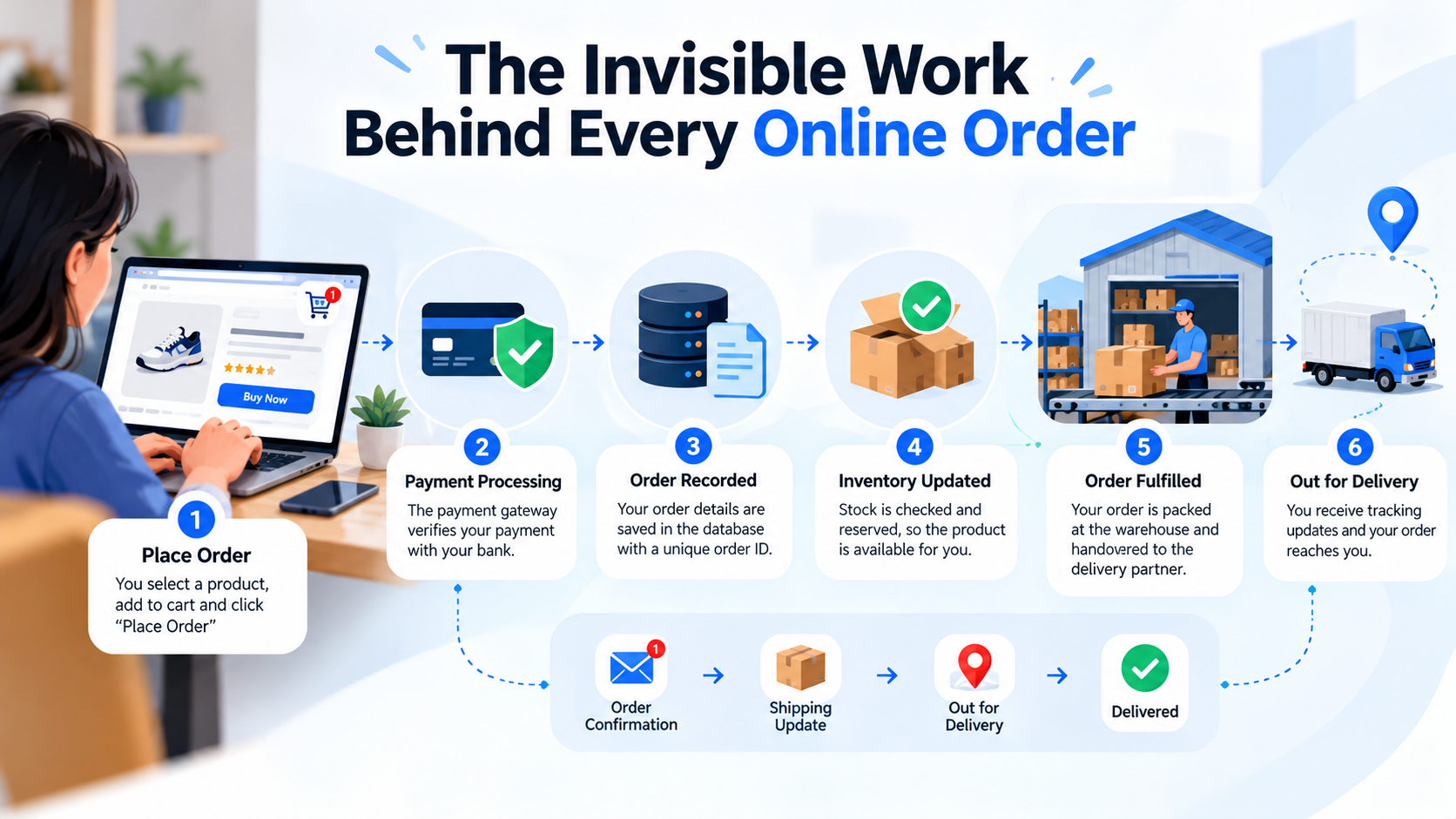
Have you ever wondered what happens after you click “Place Order” on an online shopping website? Within seconds, you may receive an order confirmation, and a few days later, your package arrives at your doorstep. The entire process feels simple, but behind that single click, several technologies work together to make the experience possible. From processing payments to updating stock and coordinating deliveries, every step depends on software systems communicating with one another.
1. It All Begins With a Click
When you select a product, add it to your cart, and click “Place Order,” the website collects the necessary information, including the product details, quantity, delivery address, and payment preference. The frontend, which is the part of the website you interact with, sends this information to the backend for processing. The backend checks the request, applies the necessary business rules, and coordinates the next steps. What looks like a simple button click is actually the beginning of a sequence of operations happening behind the scenes.
2. How the Database Records Your Order
Once the order request is processed, the application needs to store the relevant information. This is where a database becomes important. It can store details such as the order ID, products purchased, quantities, total amount, delivery address, and order status. For example, when you purchase a pair of shoes, the system records the details so the business can retrieve your order later. When you open your order history, the website uses this stored information to show your previous purchases and their current status.
3. What Happens During Payment Processing?
Online payments involve more than simply entering your card details or completing a UPI transaction. Depending on the payment method, the website communicates with a payment gateway or service provider, which coordinates the transaction with the relevant payment systems. The application then needs to establish whether the payment was successful, failed, or is still pending. Sometimes, a payment confirmation may be delayed because of network issues or a slow response from an external service. Developers must account for these situations so customers receive accurate updates and the system avoids processing the same transaction incorrectly.
4. How Inventory Management Prevents Problems
Imagine an online store that has only three units of a particular product remaining, but several customers attempt to purchase it at the same time. Without proper inventory management, the store could accidentally accept more orders than it can fulfil. Inventory systems help track available quantities and coordinate stock reservations or updates as orders are processed. This information allows the business to manage product availability and reduce the chances of accepting orders for unavailable items. The way stock is reserved and updated depends on the store's design and business rules.
5. How APIs Connect Different Systems
An online store does not necessarily manage every operation using one application. It may use a separate service for payments, another for inventory, and another for shipping. These systems need a way to exchange information, and this is where Application Programming Interfaces, commonly known as APIs, play an important role. APIs allow applications to send requests and receive responses through defined interfaces. For example, once an order is ready for shipment, the store may send the required information to a delivery provider through an API. The provider can then return shipment details or tracking updates, allowing the store to display relevant information to the customer.
6. How Order Confirmations and Delivery Updates Reach You
After the necessary order checks are completed, the website can send an order confirmation through email, SMS, WhatsApp, or an in-app notification. As the order progresses, additional updates may inform the customer that the product has been packed, shipped, or sent out for delivery. These notifications often depend on changes in the order management system or updates received from logistics providers. When the delivery status changes, the system can trigger a message to keep the customer informed. A short notification on your phone may therefore depend on several connected software components working together.
7. What Happens When Something Goes Wrong?
Not every online order follows a perfect journey. A payment might fail, a product might become unavailable, a delivery update might be delayed, or an external service might temporarily stop responding. A reliable system must be designed to handle these situations without confusing the customer or losing important information. For example, if a payment response is delayed, the application should check the transaction status before attempting another payment. Similarly, appropriate safeguards can help prevent duplicate orders when a customer clicks the order button more than once. Error handling, data consistency, and clear communication are essential parts of building dependable online shopping experiences.
8. The Technology Working Behind the Scenes
A typical online ordering process may involve a frontend, backend, database, payment integration, inventory management system, APIs, notification services, and logistics integrations. Each component performs a different task, but the overall experience depends on how effectively they work together. A small online store may use a relatively simple setup, while a large marketplace may rely on many interconnected services to handle thousands of orders. The architecture depends on the business's requirements, expected traffic, budget, security needs, and operational complexity.
Conclusion
The next time you place an online order, remember that the experience involves much more than clicking a button and waiting for a package. Behind the scenes, software systems process information, record orders, coordinate payments, manage inventory, communicate with delivery providers, and keep customers updated. Every component contributes to making the process convenient and reliable. For businesses, this highlights why an effective e-commerce website requires more than an attractive design. It needs a well-planned technical foundation that connects the customer experience with the operations happening behind it.