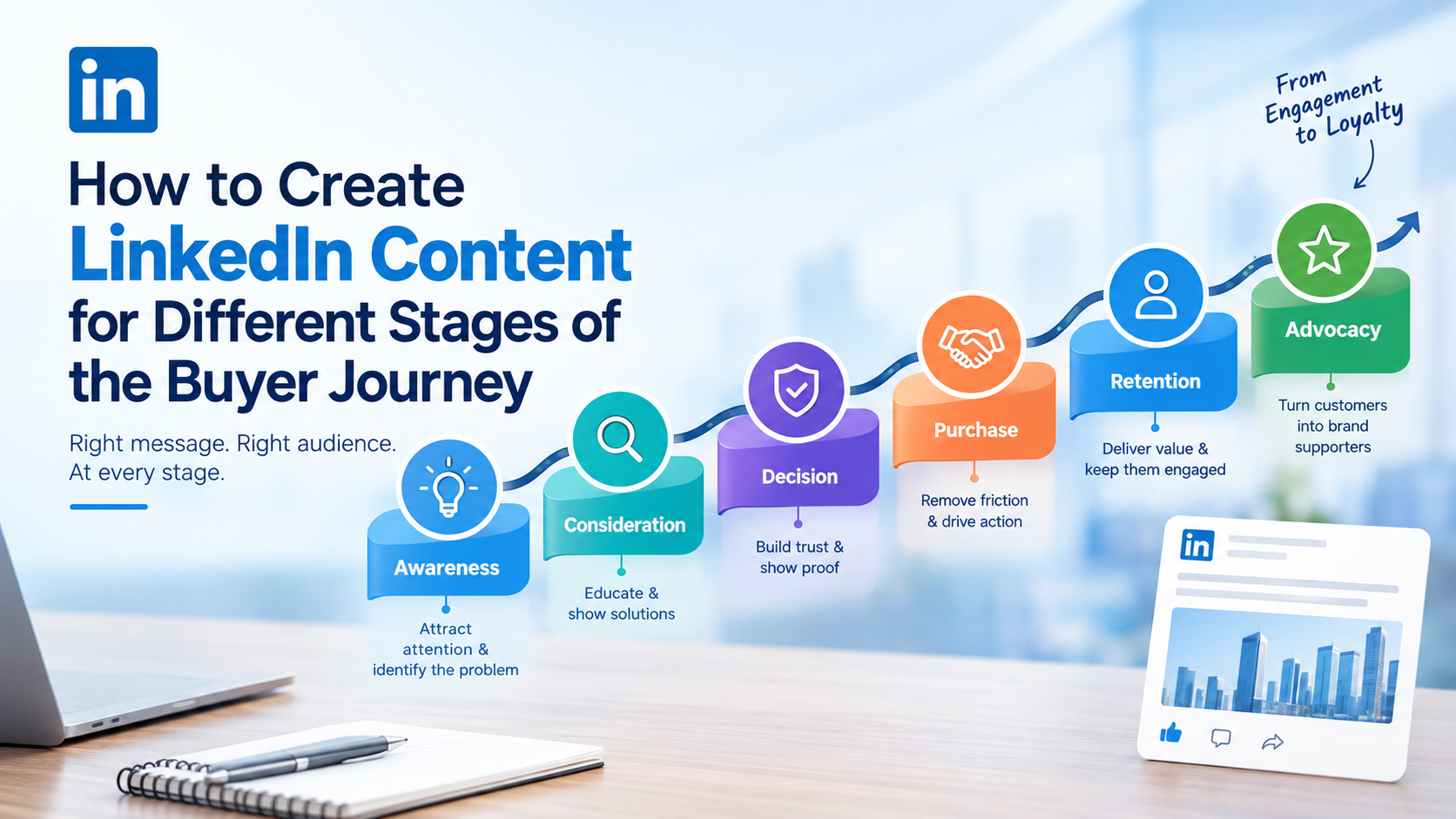
LinkedIn content for the buyer journey is more effective when it is designed around what your audience needs at each stage of the decision-making process. Not every LinkedIn user is ready to buy when they see your post. Some are discovering a problem, others are researching solutions, and some are comparing providers before making a final decision.
A strong LinkedIn content strategy should therefore move people from awareness to consideration, decision, and eventually customer loyalty. Instead of repeatedly promoting your products or services, your content should answer the questions your audience is asking at each stage.
1. Awareness Stage: Help People Discover the Problem
At the awareness stage, your audience may not even know that they need your product or service. Your goal is to attract attention and introduce a relevant problem.
Create content such as:
- Industry trends and insights
- Common business challenges
- Educational posts
- Statistics and research
- Short videos
- Industry mistakes
- “Did you know?” posts
- Thought-leadership content
For example, a digital marketing agency could publish:
“5 Reasons Your Website Gets Traffic but Generates No Leads.”
The objective is not to immediately sell an agency service. Instead, the content should make potential customers recognize a problem they may be experiencing.
2. Consideration Stage: Show Possible Solutions
Once people recognize their problem, they start looking for possible solutions. This is where your LinkedIn content should become more detailed and solution-oriented.
Useful content formats include:
- How-to guides
- Checklists
- Comparison posts
- Case studies
- Expert opinions
- Frameworks
- Webinars
- Detailed carousel posts
- Educational videos
For example, instead of simply discussing poor website performance, you could create:
“Website Redesign vs. Website Rebuild: Which Does Your Business Need?”
This type of content helps prospects understand their options while positioning your business as a knowledgeable resource.
3. Decision Stage: Build Confidence and Encourage Action
At the decision stage, potential customers are closer to purchasing. They want evidence that your company can deliver results.
Your LinkedIn content should focus on trust, proof and differentiation.
Consider publishing:
- Client success stories
- Case studies
- Testimonials
- Before-and-after results
- Product demonstrations
- Service breakdowns
- FAQs
- Pricing-related educational content
- Founder or team insights
Instead of saying:
“We provide the best CRM solutions.”
Show what makes your solution valuable. For example:
“How a CRM Automation Strategy Helped a Sales Team Reduce Manual Follow-Ups.”
Specific examples are generally more convincing than broad promotional claims.
4. Purchase Stage: Make the Next Step Easy
When a prospect is ready to take action, your content should remove friction.
Create posts with clear calls to action such as:
- Book a consultation
- Request a demo
- Download a guide
- Visit your website
- Contact your sales team
- Register for an event
- Start a free trial
Keep the CTA simple. If the post explains a complex topic and then asks the reader to complete several actions, the message can become confusing.
A better approach is:
“Want to see how this strategy could work for your business? Book a consultation with our team.”
5. Retention Stage: Continue Creating Value
The buyer journey does not end after someone becomes a customer. LinkedIn can also help businesses strengthen relationships with existing customers.
Create content around:
- Product tips
- Industry updates
- Advanced tutorials
- Customer success stories
- New features
- Frequently asked questions
- Exclusive insights
- Community discussions
This keeps your brand visible and gives existing customers additional reasons to engage with your business.
6. Advocacy Stage: Turn Customers into Brand Supporters
Satisfied customers can become powerful advocates for your brand.
Encourage customers to participate through:
- Customer interviews
- Success stories
- Testimonials
- User-generated content
- LinkedIn recommendations
- Industry discussions
- Customer spotlight posts
When customers voluntarily share their experiences, your brand gains a form of social proof that promotional content alone cannot easily replicate.
Create a LinkedIn Content Mix
A successful LinkedIn strategy should not focus entirely on one stage of the buyer journey.
A simple content mix could look like this:
| Buyer Stage | Content Goal | Examples |
|---|---|---|
| Awareness | Attract attention | Trends, statistics, educational posts |
| Consideration | Educate prospects | Guides, comparisons, frameworks |
| Decision | Build trust | Case studies, testimonials, demos |
| Purchase | Drive action | Offers, consultations, demos |
| Retention | Deliver ongoing value | Tutorials, updates, tips |
| Advocacy | Encourage referrals | Customer stories, testimonials |
The exact percentage should depend on your audience and business goals. B2B brands with long sales cycles may need more educational content, while businesses with simpler purchasing decisions may use more conversion-focused posts.
Use Different Content Formats
LinkedIn gives businesses several ways to communicate with their audience. Instead of publishing the same type of post repeatedly, match the format to the purpose.
Text posts can be useful for opinions, stories and thought leadership.
Carousels work well for educational frameworks, checklists and step-by-step guides.
Videos can demonstrate products, explain concepts or introduce team members.
Polls can encourage engagement and help you understand your audience.
Case studies are particularly useful for demonstrating real-world results.
The most important factor is not simply the format—it is whether the content addresses the audience's current needs.
Measure Content Performance by Journey Stage
Likes and comments are useful indicators, but they do not tell the entire story.
Track metrics according to your objective:
Awareness: impressions, reach, profile views and follower growth.
Consideration: engagement rate, saves, shares, website visits and content downloads.
Decision: qualified leads, demo requests, enquiries and conversion rate.
Retention: customer engagement, repeat interactions and customer-generated content.
This approach helps you identify which content actually contributes to business outcomes rather than simply generating surface-level engagement.
Conclusion
Creating LinkedIn content for different stages of the buyer journey allows businesses to communicate with prospects based on where they are in the decision-making process.
Instead of constantly asking people to buy, use LinkedIn to educate, build trust, demonstrate expertise, provide proof and make the next step easier.
A strong strategy connects awareness content with consideration content, consideration with decision-making, and customer relationships with advocacy. When every stage has a clear content purpose, LinkedIn becomes more than a platform for posting—it becomes an important part of your marketing and customer acquisition strategy.