Introduction
LinkedIn hooks are one of the most important elements of a successful LinkedIn post. With professionals, entrepreneurs, recruiters, marketers, and business leaders constantly scrolling through their feeds, you have only a few seconds to capture their attention.
A strong hook gives people a reason to pause. It can create curiosity, highlight a problem, challenge an assumption, promise useful information, or make the reader feel that the post is directly relevant to them.
The goal is not to use clickbait. Instead, an effective LinkedIn hook should create genuine interest and make the reader want to discover what comes next.
What Is a LinkedIn Hook?
A LinkedIn hook is the opening line or first few lines of a LinkedIn post designed to capture the reader's attention.
For example:
Weak:
"Today I want to share some LinkedIn marketing tips."
Stronger:
"Your LinkedIn posts may not have a content problem. They may have a hook problem."
The second version immediately introduces a potential problem and creates curiosity.
A good hook should make the reader think, "This is relevant to me. I want to know more."
Why LinkedIn Hooks Matter
LinkedIn is a crowded platform. Every day, users see posts about career advice, business growth, leadership, marketing, entrepreneurship, hiring, sales, and personal experiences.
Even excellent content can be ignored if the introduction fails to attract attention.
A strong LinkedIn hook can help you:
-
Increase post readability
-
Encourage users to stop scrolling
-
Generate more engagement
-
Build curiosity
-
Improve content retention
-
Make your message easier to understand
-
Attract your target audience
-
Encourage comments and conversations
The hook does not guarantee viral content, but it significantly improves the chances that people will actually read your message.
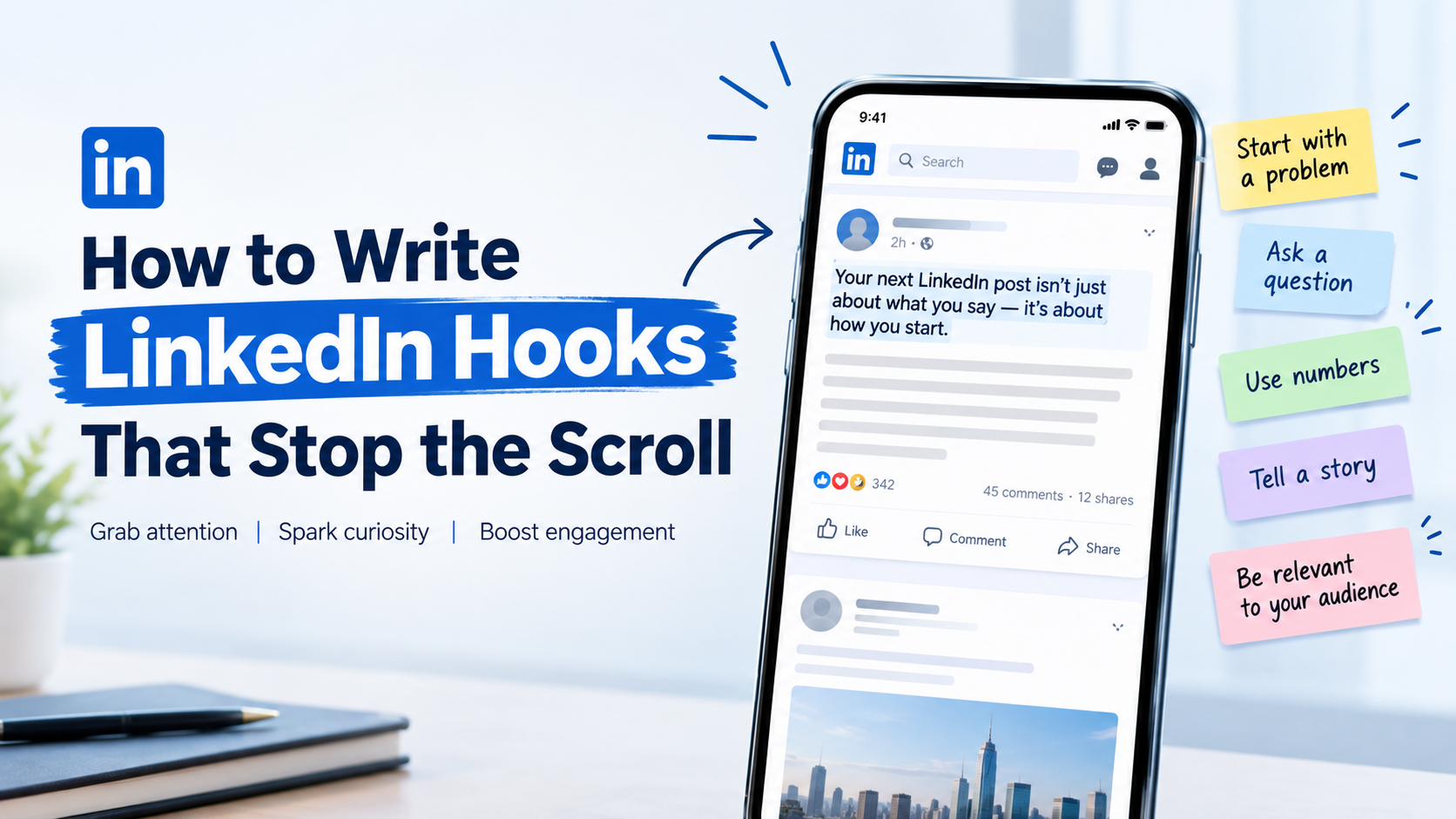
1. Start With a Problem
One of the simplest ways to create a strong LinkedIn hook is to address a problem your target audience already experiences.
For example:
"Most businesses don't have a lead-generation problem. They have a follow-up problem."
This works because it challenges the reader to reconsider something they may already believe.
If your audience frequently struggles with a particular issue, start your post by addressing it directly.
2. Create Curiosity
Curiosity is a powerful reason for someone to continue reading.
Instead of immediately explaining everything, introduce an interesting observation or unanswered question.
Examples:
-
"I stopped posting on LinkedIn for 30 days. Here's what happened."
-
"The best LinkedIn strategy I learned had nothing to do with posting more."
-
"This small change completely improved the way I approach LinkedIn content."
The key is to make sure your post actually delivers on the curiosity created by the hook.
3. Use Numbers and Specific Results
Specific numbers can make a hook more concrete and believable.
For example:
"We changed one part of our LinkedIn strategy and doubled our weekly conversations."
Or:
"5 LinkedIn mistakes can quietly reduce your post engagement."
Numbers work particularly well for educational, marketing, business, and data-driven content.
However, avoid using numbers simply to make a claim sound impressive. The information should be genuine and relevant.
4. Challenge a Common Belief
Another effective approach is to challenge something your audience commonly assumes.
For example:
"You don't need to post on LinkedIn every day to build a strong personal brand."
This creates tension between what people expect and what you are about to explain.
Contrarian hooks can perform well because they encourage readers to reconsider their existing approach.
5. Make the Hook Audience-Specific
Generic hooks often struggle because they do not immediately identify who the post is for.
Instead of:
"Here are some LinkedIn tips."
Try:
"If you're a small-business owner struggling to generate leads on LinkedIn, start here."
This immediately tells the right audience that the content is relevant to them.
Understanding your target audience is therefore essential when writing LinkedIn hooks.
6. Tell a Short Story
Stories naturally create curiosity.
You can begin with a personal experience, mistake, conversation, failure, or unexpected lesson.
For example:
"Three months ago, I thought posting more was the answer. I was wrong."
The reader now has a reason to discover what happened next.
Story-based hooks are particularly useful for personal branding because they make professional content feel more human and relatable.
7. Use a Strong One-Liner
Sometimes the most effective hook is extremely simple.
For example:
"Attention is earned, not demanded."
Or:
"Your audience doesn't owe you their attention."
A short, thought-provoking statement can stop the scroll when it communicates a strong idea clearly.
8. Ask a Relevant Question
Questions can encourage readers to mentally respond before they even continue reading.
Examples:
-
"Would you hire someone based only on their LinkedIn profile?"
-
"Why do some LinkedIn posts get hundreds of comments while others get ignored?"
-
"What would happen if you stopped trying to sound professional on LinkedIn?"
The question should be specific enough to make your target audience feel involved.
9. Focus on the Value You Are Offering
Another effective technique is to clearly communicate what the reader will learn.
For example:
"Here are 7 LinkedIn hook formulas you can use for your next post."
This works because the reader immediately understands the value of continuing.
When using this format, make sure the post actually delivers the promised information.
10. Avoid Clickbait
A powerful hook should create curiosity without misleading the audience.
Avoid exaggerated statements such as:
"This one LinkedIn trick will make you famous overnight."
Instead, use honest curiosity:
"This small change can make your LinkedIn posts significantly easier to read."
Trust is more valuable than short-term clicks. Your hook should accurately represent the content that follows.
LinkedIn Hook Formulas You Can Use
Here are some simple formulas you can adapt:
Problem Hook:
"Struggling with [problem]? Here's what might actually be going wrong."
Contrarian Hook:
"Everyone says [common belief]. I don't agree."
Curiosity Hook:
"I didn't expect this LinkedIn strategy to work. But it did."
Number Hook:
"7 LinkedIn mistakes that can hurt your personal brand."
Story Hook:
"Six months ago, I made a mistake that changed how I use LinkedIn."
Question Hook:
"Why do some LinkedIn posts get attention while others disappear?"
Lesson Hook:
"One of the biggest lessons I've learned about LinkedIn marketing is this."
Audience-Specific Hook:
"If you're a founder trying to generate leads through LinkedIn, read this."
How to Make Your LinkedIn Hooks Better
Writing a strong hook becomes easier when you focus on three questions:
Who are you talking to?
Know your audience before writing the first line.
What problem do they care about?
Your hook should connect with a real need, frustration, ambition, or curiosity.
Why should they continue reading?
Give them a clear reason to invest their attention in your post.
A useful test is to read only the first two lines of your post. Ask yourself: Would I stop scrolling if I saw this in my LinkedIn feed?
If the answer is no, rewrite it.
Common LinkedIn Hook Mistakes
Many creators make their hooks weaker by:
-
Starting with unnecessary introductions
-
Using overly complicated language
-
Making vague statements
-
Trying too hard to sound professional
-
Using excessive emojis
-
Making unrealistic claims
-
Writing extremely long opening paragraphs
-
Using clickbait
-
Focusing on themselves instead of the audience
The best hooks are usually clear, specific, relevant, and easy to understand.
Final Thoughts
A strong LinkedIn post does not begin with the main lesson. It begins with a reason to listen.
LinkedIn hooks help you earn that initial attention. Whether you use a question, story, surprising statement, problem, number, or contrarian idea, your opening should make the reader want to continue.
Experiment with different hook styles, track which posts generate meaningful engagement, and keep improving your approach.
Remember: You don't need to make every hook viral. You need to make it relevant enough for the right person to stop scrolling.