Your website is often the first place potential customers interact with your business. If it looks outdated, loads slowly, provides a poor mobile experience, or makes it difficult for visitors to find information, it may be time for an upgrade. But an important question comes first: Do you need a website redesign or a complete website rebuild?
Although these terms are often used interchangeably, they involve different levels of work, investment, and technical change. Understanding the difference can help your business choose the right approach.
What Is a Website Redesign?
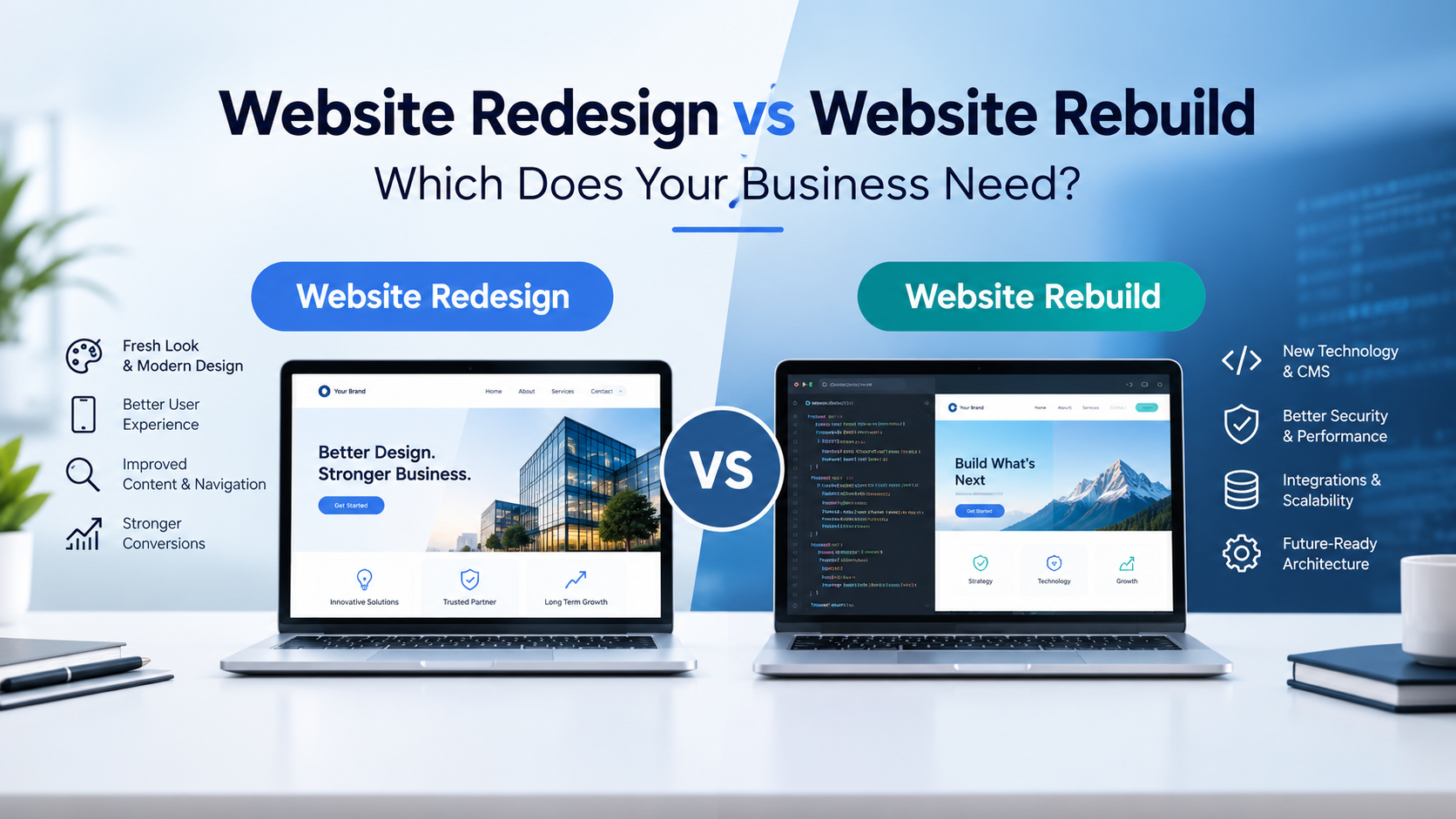
A website redesign focuses primarily on improving the appearance, usability, content structure, and overall user experience of an existing website.
The underlying technology and website structure may remain largely the same while important visual and functional elements are improved.
A redesign may include:
- Updating the website's visual design
- Improving navigation and page layouts
- Making the website mobile-friendly
- Updating fonts, colors, images, and branding
- Improving calls-to-action
- Refreshing website content
- Optimizing important landing pages
- Improving user experience
- Making minor performance improvements
A redesign is generally suitable when your existing website has a stable technical foundation but needs a modern look and better user experience.
What Is a Website Rebuild?
A website rebuild is a much more comprehensive process. Instead of simply improving the existing website, developers may rebuild the website's technical infrastructure, architecture, content management system, or codebase.
A rebuild may involve:
- Moving to a new CMS or technology
- Rewriting the website's code
- Changing the website architecture
- Rebuilding databases or integrations
- Improving website security
- Reorganizing the entire content structure
- Rebuilding ecommerce functionality
- Improving website scalability
- Replacing outdated plugins or systems
A rebuild is usually necessary when the existing website has fundamental technical limitations that cannot be effectively solved through design changes alone.
Website Redesign vs Website Rebuild: Key Difference
The simplest way to understand the difference is this:
A website redesign improves what users see and experience, while a website rebuild can change how the website works underneath.
For example, if your website looks outdated but still has reliable technology, a redesign may be enough.
However, if your website is built on outdated technology, frequently experiences errors, cannot integrate with modern business tools, or has serious performance and security issues, a rebuild may be the better solution.
When Should Your Business Choose a Website Redesign?
A redesign may be the right choice if your current website:
- Looks outdated compared with competitors
- Has an inconsistent brand identity
- Needs better navigation
- Performs reasonably well technically
- Is already built on a suitable CMS
- Needs improved mobile responsiveness
- Has good functionality but poor visual presentation
- Needs stronger conversion-focused landing pages
In these situations, completely rebuilding the website could be unnecessary and more expensive than required.
When Should Your Business Choose a Website Rebuild?
A rebuild may be necessary if your website:
- Uses outdated technology
- Has serious security vulnerabilities
- Loads extremely slowly because of its architecture
- Frequently crashes or produces technical errors
- Cannot support new features
- Has poor integrations with CRM, payment, analytics, or marketing systems
- Has an outdated CMS that is difficult to maintain
- Has a complicated or poorly structured codebase
- Needs major changes to its functionality
- Cannot scale with your growing business
If the technical foundation is holding your business back, a redesign alone may only provide a temporary improvement.
Consider SEO Before Making Changes
Whether you choose a redesign or rebuild, SEO should be part of the process from the beginning.
Changing website pages, URLs, navigation, content, or site structure without proper planning can negatively affect organic search visibility.
Before launching an updated website, businesses should review:
- Existing URLs
- High-performing pages
- Internal links
- Metadata
- Search rankings
- Backlinks
- Redirects
- Sitemap
- Mobile usability
- Page speed
- Structured data
For a rebuild, proper URL mapping and redirects are particularly important because the website structure may change significantly.
Cost: Redesign vs Rebuild
The cost depends on the size and complexity of the website, but generally, a redesign requires less development work than a complete rebuild.
A redesign may focus on selected pages, layouts, branding, and user experience. A rebuild can involve development, migration, integrations, testing, data migration, security, SEO, and technical infrastructure.
However, the cheapest option is not always the best option.
If an outdated technical foundation is creating recurring maintenance costs and preventing growth, investing in a rebuild may provide better long-term value.
How to Decide Which One You Need
Ask yourself these five questions:
1. Does the website work reliably?
If yes, a redesign may be sufficient.
2. Is the main problem visual or technical?
Visual problems generally point toward a redesign, while major technical problems may require a rebuild.
3. Can your current technology support future requirements?
If your website cannot support planned features or integrations, consider a rebuild.
4. Is your website secure and maintainable?
If security and maintenance are major concerns, rebuilding may be necessary.
5. Will your business grow significantly in the next few years?
A scalable website architecture can make future growth easier and reduce the need for another major rebuild.
Final Thoughts
Choosing between a website redesign and website rebuild depends on the condition of your current website and your business goals.
If your website has a solid technical foundation but needs a modern appearance, improved navigation, better content, and a stronger user experience, a redesign may be the smarter choice.
If the technology, architecture, security, performance, or functionality of your website is outdated, a rebuild can provide a stronger foundation for long-term growth.
Before making a decision, evaluate both the visible problems and the technical foundation of your website. The right investment should not only make your website look better—it should make it faster, easier to use, easier to manage, and better prepared for business growth.