
Introduction
Digital transformation has become an important priority for businesses that want to remain competitive in a technology-driven market. Companies across industries are moving away from manual processes, disconnected systems, spreadsheets, and outdated software toward digital solutions that can improve efficiency and support better decision-making. However, digital transformation is not simply about adopting new technology. It is about using technology strategically to improve the way a business operates, serves customers, manages information, and creates value.
One of the most important technologies supporting this transition is custom software. Unlike generic software designed for a broad audience, custom software is developed around the specific requirements, workflows, goals, and challenges of an individual business. This makes it particularly useful for organizations that need technology to adapt to their operations rather than forcing their operations to adapt to an existing product.
As businesses continue to adopt artificial intelligence, automation, cloud technologies, data analytics, and integrated digital platforms, custom software can provide the foundation needed to bring these technologies together. From automating repetitive tasks to connecting business systems and improving customer experiences, custom software can play a significant role in a successful digital transformation strategy.
What Is Digital Transformation?
Digital transformation refers to the process of using digital technologies to fundamentally improve business operations, customer experiences, decision-making, and overall organizational performance. It goes beyond simply moving from paper-based processes to digital documents or purchasing new software.
A successful digital transformation can involve automation, cloud computing, artificial intelligence, data analytics, digital customer platforms, application development, system integration, and other technologies. The goal is to create a more efficient, connected, flexible, and data-driven organization.
For example, a business that previously managed customer information through spreadsheets may move to an integrated software platform where customer data, sales activity, communication, reporting, and follow-ups are managed in one place. Similarly, a company that relies heavily on manual data entry may introduce automation to reduce repetitive work and improve accuracy.
This is where custom software becomes particularly valuable. Instead of simply adding another disconnected application to an organization, businesses can develop software around their actual processes and integrate it with their existing technology ecosystem.
Why Custom Software Matters in Digital Transformation
Every business has different processes, customers, employees, and operational requirements. Generic software can solve common problems, but it may not always address the specific challenges faced by an organization. Businesses may end up paying for features they do not use while still relying on spreadsheets, manual work, or additional tools to handle processes that the software cannot support.
Custom software takes a different approach. It is designed around the organization's specific requirements. Developers can analyze existing workflows, identify inefficiencies, and create a solution that directly addresses those challenges.
This makes custom software an important component of digital transformation because it allows technology to become closely aligned with business objectives. Instead of changing an entire workflow to fit a software product, businesses can build software that supports the workflow they actually need.
Improving Business Process Automation
One of the biggest advantages of custom software in digital transformation is its ability to automate business processes. Many organizations still spend significant amounts of time on repetitive tasks such as data entry, document processing, reporting, customer follow-ups, inventory updates, and administrative activities.
When these processes are performed manually, they can consume employee time and increase the possibility of human error. Custom software can automate repetitive workflows and allow employees to focus on activities that require creativity, communication, analysis, and strategic thinking.
For example, a custom application could automatically collect information from different sources, update internal records, generate reports, send notifications, or trigger follow-up actions based on predefined conditions. This can reduce unnecessary manual work while creating a more consistent operational process.
Automation should not simply be about replacing human effort. The goal should be to create more efficient workflows where technology handles repetitive activities and employees can concentrate on higher-value responsibilities.
Connecting Disconnected Business Systems
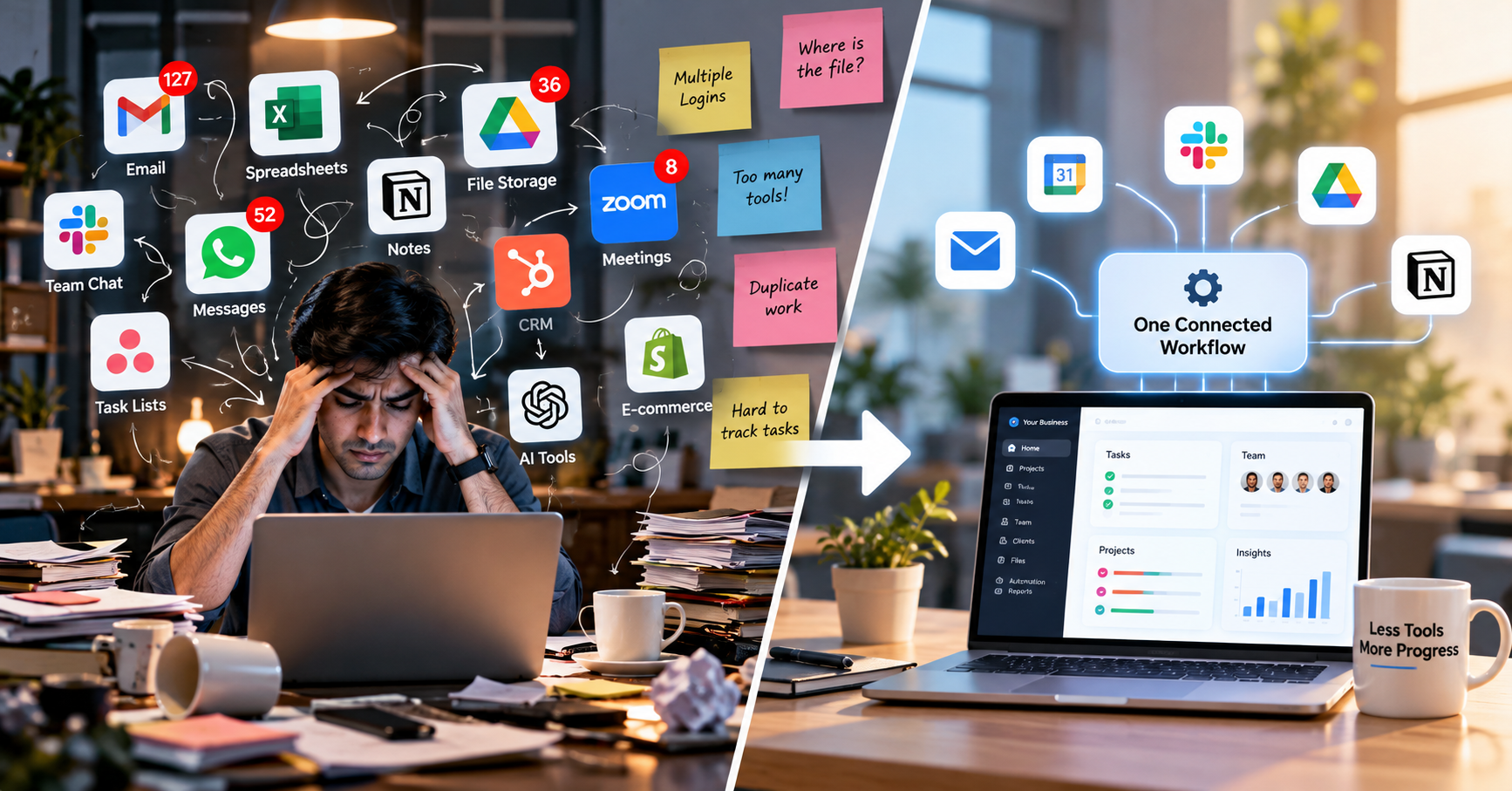
Many businesses use multiple software applications for different departments. Sales teams may use one platform, finance teams another, while customer support, inventory, marketing, and operations may rely on completely different systems.
When these platforms do not communicate effectively, information can become fragmented. Employees may have to enter the same information multiple times or manually transfer data from one system to another. This can slow down operations and make it difficult for management to get a complete picture of the business.
Custom software can help solve this problem through system integration. A customized solution can connect different applications and create a more unified flow of information.
For example, customer information collected by a sales platform could be connected with billing, customer support, or reporting systems. Instead of maintaining multiple versions of the same information, businesses can create a more connected technology environment.
This type of integration is particularly important for digital transformation because transformation becomes much more effective when business systems can work together.
Creating Better Customer Experiences
Digital transformation is not only about improving internal operations. Customer experience is another major part of the transformation process.
Customers increasingly expect businesses to provide fast, convenient, personalized, and consistent digital experiences. Slow processes, repeated requests for information, poor communication, and outdated interfaces can negatively affect customer satisfaction.
Custom software can help businesses create digital experiences that are specifically designed around their customers. Depending on the business model, this could include customer portals, mobile applications, self-service platforms, personalized dashboards, automated communication systems, or online service platforms.
Because the software is developed according to the organization's specific customer journey, businesses can focus on solving the actual problems their customers face rather than simply adding generic features.
Supporting Data-Driven Decision-Making
Data has become one of the most valuable resources for modern businesses. However, simply collecting large amounts of data does not automatically improve decision-making. Organizations need systems that can organize, process, analyze, and present information in a useful way.
Custom software can provide businesses with dashboards, reports, analytics tools, and automated data processing capabilities. Decision-makers can use these tools to monitor important business metrics and identify trends.
For example, a customized business platform could provide information about sales performance, customer activity, operational efficiency, inventory levels, or service requests. Instead of manually collecting information from different sources, managers can access relevant data through a centralized system.
Better access to reliable information can help organizations make faster and more informed decisions.
Improving Scalability
A digital solution that works for a small business today may not be sufficient when the organization grows. As the number of customers, employees, transactions, and business processes increases, technology needs to scale with the organization.
Custom software can be designed with future growth in mind. Developers can build systems that are capable of handling increasing workloads and adding new features as business requirements change.
This does not mean every organization needs a highly complex system from the beginning. Instead, businesses can develop software in stages and introduce additional capabilities as their needs evolve.
Scalability is particularly important in digital transformation because transformation is an ongoing process rather than a one-time project.
Enhancing Operational Efficiency
Operational efficiency is one of the main reasons businesses invest in digital transformation. Organizations want to reduce unnecessary processes, minimize errors, save time, and make better use of available resources.
Custom software can improve efficiency by analyzing existing workflows and identifying areas where technology can simplify operations. A customized system can remove unnecessary steps, automate routine activities, centralize information, and provide employees with tools designed around their actual responsibilities.
For example, instead of employees switching between several applications to complete one task, a custom platform may bring relevant information and functions into a single interface.
The result can be a smoother workflow and a more productive workforce.
Making Artificial Intelligence More Useful
Artificial intelligence is becoming increasingly important in digital transformation. Businesses are exploring AI for customer support, data analysis, content generation, forecasting, automation, recommendations, and many other applications.
However, AI becomes more valuable when it is connected to the right business data and workflows. Custom software can provide the infrastructure needed to integrate AI into existing operations.
For example, a business could develop a customized application that uses AI to analyze customer inquiries, summarize information, identify patterns, recommend actions, or automate repetitive tasks.
Rather than adopting AI simply because it is a popular technology, organizations can integrate AI into specific workflows where it can create measurable value.
Strengthening Data Management and Security
Digital transformation often means that businesses generate and store more digital information than ever before. Customer information, financial records, employee data, business documents, and operational data may all need to be protected.
Custom software can be developed with the organization's specific data-management and security requirements in mind. Depending on the application, this can include user access controls, authentication, permissions, activity tracking, encryption, backups, and other security measures.
A well-designed system can also make it easier to control who has access to particular information. This becomes increasingly important as businesses move toward more connected and data-driven operations.
Security should not be treated as an additional feature added at the end of a software project. It should be considered from the beginning of the development process.
Reducing Dependence on Spreadsheets
Spreadsheets can be useful for small-scale tasks, but businesses can face challenges when they rely on spreadsheets to manage complex and growing operations.
Multiple versions of files, accidental changes, duplicated information, limited collaboration, and manual updates can create operational problems. As organizations grow, spreadsheet-based workflows can become difficult to manage.
Custom software provides an opportunity to move important processes into a centralized system. Instead of maintaining multiple spreadsheets, businesses can use a dedicated platform for managing information, workflows, reports, and operations.
This does not mean spreadsheets should disappear completely. Rather, businesses should identify processes where spreadsheets are no longer efficient and consider whether dedicated software would provide a better solution.
Supporting Remote and Distributed Teams
Modern businesses increasingly operate with employees working from different locations. This creates a need for digital systems that allow teams to access information and collaborate effectively.
Custom software can be developed to support remote workflows by providing centralized access to business information, task management, reporting, communication, and other functions.
A well-designed digital platform can reduce dependence on physical documents and location-specific processes, allowing employees to access the tools they need from different locations.
This can make organizations more flexible and resilient.
Custom Software vs Off-the-Shelf Software
Off-the-shelf software can be a practical choice for businesses that need common features and want to start quickly. It is often easier to deploy and may have lower initial costs.
However, businesses may encounter limitations when their requirements become more specialized. They may need to purchase additional tools, pay for multiple subscriptions, or modify their processes to fit the software.
Custom software takes a different approach by focusing on the organization's specific requirements. Although development can require greater initial investment, the solution can provide greater flexibility and integration possibilities.
The right choice depends on the organization's goals, budget, processes, technical requirements, and long-term plans. Digital transformation does not automatically mean that every business needs completely custom software. The important question is whether the technology can effectively support the organization's objectives.
The Role of Custom Software in Long-Term Digital Strategy
Digital transformation should not be viewed as a one-time technology upgrade. Businesses continuously change as customer expectations, markets, technologies, and internal requirements evolve.
Custom software can support this long-term transformation by providing a technology foundation that can evolve with the business. New features, integrations, automation capabilities, analytics tools, and AI functionality can potentially be added as requirements change.
This flexibility can be valuable for businesses that expect significant growth or operate in industries where processes are highly specialized.
Challenges to Consider Before Developing Custom Software
While custom software offers many advantages, businesses should carefully evaluate their requirements before beginning development. Building software without a clear understanding of the underlying business problem can lead to unnecessary costs and complexity.
Organizations should first identify the processes they want to improve, the problems employees and customers experience, and the outcomes they want to achieve. They should also consider factors such as development costs, maintenance, scalability, security, integrations, user adoption, and future requirements.
Employee involvement is also important. The people who use a system every day can provide valuable insight into what works, what does not, and what improvements are needed.
A successful custom software project should therefore begin with business analysis and planning rather than jumping directly into development.
How Businesses Can Start Their Digital Transformation Journey
Businesses do not necessarily need to transform every process at once. A better approach is often to identify a specific problem that has a measurable impact on productivity, cost, customer experience, or revenue.
The organization can then evaluate whether automation, integration, custom software, or another digital solution can address that problem. Starting with a focused project can make it easier to measure results and learn from the implementation.
Once the first solution proves successful, businesses can gradually expand their digital transformation initiatives to other areas.
This approach can make digital transformation more manageable while reducing the risks associated with large-scale technology projects.
Conclusion
Custom software can play a significant role in helping businesses achieve meaningful digital transformation. By providing solutions designed around specific business requirements, custom software can improve automation, connect disconnected systems, enhance customer experiences, support data-driven decision-making, improve operational efficiency, and provide the flexibility needed for future growth.
The value of custom software is not simply in creating another digital tool. Its real value lies in solving business problems through technology. When software is aligned with business objectives, it can become an important part of an organization's long-term digital strategy.
As artificial intelligence, automation, cloud computing, analytics, and other technologies continue to reshape the business landscape, organizations will increasingly need technology that can adapt to their unique requirements. For businesses looking to move beyond disconnected tools and build more efficient digital operations, custom software development can be an important step toward sustainable digital transformation.
For organizations evaluating their next stage of digital growth, the starting point should be simple: identify the processes that are slowing the business down, understand what customers and employees need, and determine where technology can create measurable improvements. The right custom software solution can then turn those opportunities into practical, scalable digital capabilities.
To read more such articles kindly visit: Devobyte