Introduction
The e-commerce industry is growing rapidly as more consumers turn to online shopping for convenience, competitive pricing, and a wider range of products. However, as online retail businesses expand, managing increasing website traffic, maintaining fast page-loading speeds, and ensuring smooth transactions become significant technical challenges. During major shopping events, seasonal sales, and promotional campaigns, e-commerce platforms may experience sudden spikes in visitors, placing considerable pressure on their underlying technology infrastructure.
Choosing the right e-commerce architecture is essential for businesses that want to deliver reliable shopping experiences while preparing for future growth. A well-designed architecture helps retailers manage high traffic volumes, process transactions efficiently, protect customer information, and integrate new technologies without disrupting existing operations. For businesses investing in digital transformation, understanding the different types of e-commerce architecture can help them make informed decisions about performance, scalability, security, and long-term costs.
What Is E-commerce Architecture?
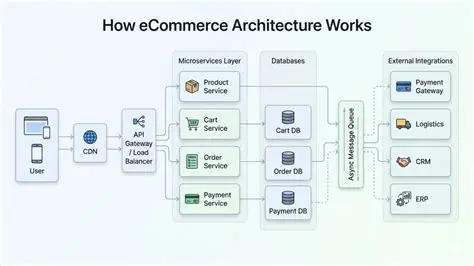
E-commerce architecture refers to the underlying structure of an online retail platform, including its frontend interface, backend services, databases, integrations, and infrastructure. These components work together to provide essential shopping functionalities, such as product browsing, search, inventory management, shopping carts, payment processing, order tracking, and customer account management.
A typical e-commerce platform consists of several interconnected layers. The frontend is the part of the website or application that customers interact with, while the backend handles business logic, pricing, inventory updates, order processing, and other operations. The database stores information about products, customers, orders, and stock levels. Additional services connect the platform to payment gateways, shipping providers, customer relationship management systems, and marketing tools.
For high-traffic retail platforms, these components must communicate efficiently and remain reliable even when thousands of customers browse products or place orders simultaneously. Selecting an appropriate architecture helps businesses prevent performance bottlenecks and build a platform that can accommodate increasing demand.
Why E-commerce Architecture Matters for High-Traffic Retail Platforms
Website performance has a direct influence on the online shopping experience. Customers expect product pages to load quickly, search results to appear without unnecessary delays, and checkout processes to work smoothly. When an e-commerce website becomes slow or unavailable, customers may abandon their carts and purchase products from competitors instead.
High-traffic retail platforms face additional challenges because different operations place different demands on the system. Product browsing generates frequent read requests, inventory management requires accurate stock information, and checkout involves sensitive transactions that must be processed reliably. A sudden increase in activity can overwhelm an architecture that has not been designed to handle these workloads.
The right architecture allows businesses to distribute workloads, scale critical services, and identify performance problems before they affect customers. It also improves operational flexibility by allowing development teams to introduce new features, connect third-party services, and optimise individual components without rebuilding the entire platform.
Understanding the Main Types of E-commerce Architecture
Monolithic Architecture
Monolithic architecture combines most application functionality into a single, unified codebase and deployment unit. Product catalogues, customer accounts, shopping carts, checkout processes, and order management may all operate within the same application.
One of the main advantages of monolithic architecture is its simplicity. It is generally easier to develop, test, deploy, and maintain during the early stages of a project. For small and medium-sized retailers with predictable traffic and relatively straightforward requirements, a monolithic system can provide a practical and cost-effective starting point.
However, monolithic architecture can become challenging when an online store experiences substantial growth. Scaling the application may require duplicating the entire application even when only one component needs additional resources. Changes to one area can also affect other parts of the system, making testing and deployment more complicated as the codebase expands.
A well-optimised monolithic platform can still support significant traffic, particularly when combined with caching, database optimisation, load balancing, and suitable infrastructure. Therefore, businesses should not assume that monolithic architecture is automatically unsuitable for large retail operations. Its limitations become more relevant when different components have significantly different scaling requirements or when frequent independent deployments are necessary.
Microservices Architecture
Microservices architecture divides an e-commerce application into smaller, independent services that communicate through APIs or messaging systems. For example, product catalogues, inventory management, customer accounts, payments, search, and order processing can operate as separate services.
This approach provides greater flexibility for high-traffic retail platforms because individual services can be scaled according to demand. If product searches increase sharply during a promotional event, the search service can receive additional resources without requiring every other service to scale at the same rate.
Microservices can also enable independent development and deployment. Teams can update particular functionalities without releasing the entire application, provided service contracts and dependencies are managed carefully. This can support faster innovation and help large retail businesses adapt to changing customer expectations.
However, microservices introduce additional complexity. Communication between services can create network delays, distributed transactions require careful design, and monitoring becomes more demanding. Businesses must also manage service discovery, authentication, API security, observability, and failure recovery.
Microservices architecture is most appropriate when a retailer has sufficient technical expertise, operational maturity, and a genuine need for independent scaling or deployment. For smaller businesses, adopting microservices too early may increase costs and complexity without delivering meaningful benefits.
Modular Monolithic Architecture
A modular monolith combines the simplicity of a single deployable application with clearly separated internal modules. Product management, checkout, inventory, customer accounts, and other functions remain within one application but are organised into distinct components with defined responsibilities.
This architecture can be a strong middle ground for retailers that need a maintainable platform without the operational overhead of a full microservices environment. Developers can work on individual modules while retaining simpler deployment and communication patterns.
As the business grows, specific modules can potentially be extracted into independent services when clear performance or organisational requirements justify the change. This allows businesses to evolve their architecture gradually rather than introducing unnecessary complexity at the beginning.
For many growing retailers, a modular monolith offers a sensible balance between maintainability, cost, and scalability.
Headless and Composable Commerce Architecture
Headless commerce separates the customer-facing presentation layer from the commerce backend. The frontend communicates with backend services through APIs, allowing businesses to create different shopping experiences across websites, mobile applications, digital kiosks, and other customer touchpoints.
Composable commerce extends this concept by allowing retailers to combine specialised services for different business functions. A platform might use one system for product information, another for search, a separate payment provider, and an independent commerce engine for transactions.
This approach gives businesses greater freedom to select technologies that match their needs. Retailers can update their frontend independently, experiment with new customer experiences, and integrate specialised tools without replacing the entire platform.
However, composable architecture requires reliable API integration, careful data management, and effective coordination between services. More independent components can also mean more vendors, contracts, monitoring requirements, and potential points of failure.
For retailers operating across multiple channels or markets, headless and composable commerce can provide substantial flexibility. The best results come when the business has clear integration standards and a well-defined strategy for managing the entire technology ecosystem.
Key Factors to Consider When Choosing E-commerce Architecture
Scalability and Traffic Management
Scalability is one of the most important considerations for any high-traffic retail platform. Businesses must evaluate both predictable growth and sudden traffic spikes caused by flash sales, festive shopping seasons, influencer campaigns, or product launches.
Horizontal scaling allows additional application instances to be deployed as demand increases, while vertical scaling increases the resources available to an existing instance. Horizontal scaling is often useful for handling variable traffic, although it requires applications and their dependencies to support multiple instances reliably.
Load balancers distribute incoming requests across available servers, while auto-scaling systems can adjust infrastructure capacity based on workload and performance indicators. Content delivery networks can serve static assets, such as product images, stylesheets, and scripts, from locations closer to customers.
Retailers should also consider whether databases, search engines, inventory services, and payment integrations can handle increased demand. Scaling the frontend alone will not solve bottlenecks in the checkout process or the database.
Performance and Low Latency
Fast response times are essential for maintaining customer engagement and reducing friction throughout the shopping journey. An effective architecture should minimise unnecessary processing, reduce network delays, and avoid repeatedly retrieving the same information from databases.
Caching is particularly valuable for high-traffic online stores. Frequently accessed product details, category pages, and other suitable data can be cached to reduce the workload on backend services. A content delivery network can improve the delivery of static resources, while application-level and database caching can reduce repeated computation and queries.
However, caching must be designed carefully. Prices, stock availability, personalised information, and checkout data may require different freshness and consistency rules. Incorrectly cached information can create customer frustration, overselling, or order-processing problems.
Retailers should measure real user performance and server response times instead of relying exclusively on infrastructure specifications. Performance testing under realistic workloads can reveal bottlenecks before a major sales event.
Database Design and Data Consistency
The database is a critical component of e-commerce architecture because it stores product details, customer information, inventory records, and order histories. Poor database design or inefficient queries can slow down the entire platform when traffic increases.
Relational databases are often well suited to transactional operations that require structured data and strong consistency. NoSQL databases can be useful for certain high-volume workloads involving flexible data structures or specific access patterns. Many retail platforms use a combination of database technologies rather than relying on a single solution for every requirement.
Read replicas can help distribute read-heavy workloads, while indexing, query optimisation, connection pooling, and appropriate database capacity can improve performance. Some platforms also use search engines or specialised data stores to support fast product discovery.
Inventory and checkout operations require particular attention. If multiple customers attempt to purchase the same limited-stock product, the system must prevent inconsistent stock updates. Transactional controls, atomic operations, reservation mechanisms, and idempotent request handling can help maintain data integrity.
The architecture should define where strong consistency is essential and where slightly delayed updates are acceptable. This distinction helps businesses balance performance with the accuracy required for critical transactions.
Security and Payment Protection
Security must be a core architectural requirement rather than an additional feature introduced after development. E-commerce platforms process personal information, account credentials, addresses, and payment-related data, making them attractive targets for cyberattacks.
A secure architecture should include encrypted communication, strong access controls, secure authentication, appropriate secrets management, input validation, and protection against common web application vulnerabilities. Payment integrations should follow the relevant security requirements, including applicable PCI DSS obligations when payment card data is involved.
Retailers should also consider distributed denial-of-service protection, web application firewalls, rate limiting, bot management, and fraud detection. These controls can help protect platforms from malicious traffic and abusive requests that consume resources during periods of high demand.
Sensitive information should only be collected and retained when necessary, with appropriate access restrictions and retention policies. Regular security testing, vulnerability management, logging, and incident response procedures further strengthen the platform.
A scalable architecture is only valuable when it can maintain customer trust and protect critical business operations.
Reliability and Fault Tolerance
High-traffic retailers must prepare for the possibility that individual components, cloud resources, databases, or external services may fail. An architecture that depends on every component being available at all times can create widespread disruptions when a single dependency experiences problems.
Fault-tolerant systems use techniques such as redundant infrastructure, health checks, automated recovery, controlled retries, and circuit breakers. These mechanisms can help isolate failures and prevent temporary problems from spreading across the platform.
For example, if a recommendation service becomes unavailable, customers should ideally still be able to browse products and complete purchases. Similarly, an issue with a non-essential analytics integration should not prevent order processing.
Retailers should establish recovery objectives, define acceptable downtime, and test backup restoration procedures. Disaster recovery plans should cover both infrastructure failures and data corruption, with clear responsibilities for responding to incidents.
Integration With Business Systems
An e-commerce platform rarely operates independently. It may need to exchange information with enterprise resource planning systems, customer relationship management platforms, warehouse management tools, shipping providers, accounting software, marketing automation systems, and payment gateways.
A suitable architecture should make these integrations reliable and maintainable. Well-defined APIs help different systems exchange information through consistent interfaces, while asynchronous messaging can support operations that do not need to finish during the customer's immediate request.
For example, after an order is confirmed, the platform can publish an order event for downstream systems to process. Warehouse management, customer notifications, and analytics can respond to that event without requiring every operation to complete before the customer receives confirmation.
However, asynchronous workflows need careful handling of duplicate messages, retries, delayed events, and failed processing. Idempotency controls, dead-letter queues, reconciliation processes, and monitoring can help maintain reliability.
The Role of Cloud Computing in High-Traffic E-commerce
Cloud computing provides retailers with flexible infrastructure that can adapt to changing demand. Instead of maintaining all computing resources on fixed-capacity servers, businesses can use cloud services to increase or reduce capacity according to workload requirements.
Cloud-based architectures may include managed databases, container platforms, serverless functions, object storage, content delivery networks, and automated deployment pipelines. These services can reduce infrastructure management responsibilities and help development teams focus on improving the shopping experience.
Containers can provide consistent application environments across development, testing, and production. Container orchestration platforms can automate deployment, scaling, and recovery, although they introduce operational complexity that must be justified by the platform's needs.
Serverless computing can be useful for event-driven workloads, background processing, and selected API operations. However, retailers should evaluate execution limits, cold starts, concurrency constraints, and pricing before using serverless services for critical shopping functions.
Cloud adoption does not automatically guarantee scalability or cost efficiency. Poorly configured resources, excessive data transfer, inefficient queries, and unnecessary service usage can increase operating expenses. Retailers should combine cloud infrastructure with capacity planning, performance monitoring, and cost management practices.
Monolithic vs Microservices vs Composable Architecture: Which Is Better?
There is no single architecture that is ideal for every online retailer. The right choice depends on traffic patterns, technical expertise, integration requirements, budget, deployment frequency, and the complexity of business operations.
A monolithic architecture can work well for retailers that prioritise simplicity and have relatively predictable workloads. A modular monolith is often suitable for growing businesses that need clear separation between business functions without the overhead of distributed services.
Microservices are worth considering when individual capabilities need independent scaling, teams require separate deployment cycles, or the application has become difficult to maintain as a single unit. Headless and composable commerce are particularly useful when retailers need multiple customer-facing experiences or want to combine specialised commerce technologies.
These approaches are not necessarily mutually exclusive. A retailer can use a modular backend, extract selected high-demand services into microservices, and provide a headless frontend through APIs. The most effective architecture is the one that meets current business requirements while allowing sensible evolution over time.
Best Practices for Building High-Traffic E-commerce Platforms
Successful high-traffic e-commerce architecture begins with understanding actual business requirements. Retailers should estimate normal traffic, peak concurrent users, expected transaction volumes, product catalogue size, geographic distribution, and anticipated growth. These estimates help determine infrastructure requirements and identify the components most likely to become bottlenecks.
Load testing and stress testing should be performed before major campaigns. Load testing evaluates system behaviour under expected demand, while stress testing helps identify the limits of the platform and how it behaves when capacity is exceeded. Spike testing is also valuable for simulating sudden increases in traffic.
Observability should be built into the architecture from the beginning. Centralised logs, application metrics, distributed tracing, and meaningful alerts help engineering teams understand performance issues across interconnected components. Retailers should monitor checkout success rates, error rates, database latency, payment failures, and inventory discrepancies in addition to basic server utilisation.
Automation is another important consideration. Continuous integration and continuous delivery practices can improve release consistency, while automated testing reduces the risk of introducing defects during frequent updates. Infrastructure as code can make environments more repeatable and easier to manage.
Finally, businesses should plan architecture improvements incrementally. Replacing an entire platform can be expensive and risky. Identifying measurable bottlenecks and improving the most critical components first often produces better results than adopting a complex architecture solely because it is popular.
Common Mistakes to Avoid When Selecting E-commerce Architecture
One common mistake is choosing an architecture based on trends instead of business requirements. Microservices, serverless computing, and composable commerce can deliver significant benefits, but they also introduce trade-offs. Implementing them without a clear need may increase development time, operational costs, and system complexity.
Another mistake is focusing exclusively on frontend performance while ignoring backend dependencies. A website may load quickly initially but still fail when customers search for products, update their carts, or proceed to checkout. Database capacity, payment integrations, inventory operations, and third-party service limits must all be considered.
Businesses should also avoid postponing security, monitoring, and disaster recovery planning. Adding these capabilities after the platform has grown can require expensive architectural changes. Similarly, relying on a single external service without a suitable failure-handling strategy can create unnecessary operational risk.
Underestimating total cost is another challenge. Infrastructure expenses are only part of the overall investment. Development, integration, observability, security, maintenance, training, and incident response also contribute to the long-term cost of an e-commerce platform.
The best decisions come from evaluating the complete operating model rather than comparing architectures on technical features alone.
How Custom Software Development Supports E-commerce Scalability
Every retail business has different operational requirements. A retailer managing a small product catalogue may have very different needs from a marketplace handling thousands of sellers, multiple warehouses, dynamic pricing, and high-volume transactions.
Custom software development enables businesses to design systems around their specific workflows, integration requirements, and customer experiences. Depending on the business case, a custom solution can support specialised inventory rules, automated order routing, advanced search, personalised product recommendations, and integrations with existing enterprise systems.
Custom development also allows teams to select an appropriate architecture rather than forcing every business process into a rigid, predefined structure. Developers can introduce caching, asynchronous processing, independent services, and specialised data stores where these technologies provide measurable value.
However, custom development should be guided by clear requirements and realistic cost-benefit analysis. Not every retailer needs to build every component from scratch. Combining established platforms and third-party services with carefully selected custom functionality can often deliver a more practical result.
Working with an experienced software development partner can help retailers assess their current infrastructure, identify technical limitations, plan a scalable architecture, and establish a roadmap for future improvements.
Future Trends in E-commerce Architecture
E-commerce architecture continues to evolve as customer expectations and retail technology change. Artificial intelligence is increasingly being used for product recommendations, conversational shopping assistants, fraud detection, demand forecasting, and customer support. These capabilities can require reliable data pipelines, scalable inference services, and secure integrations with existing commerce systems.
Composable commerce is also gaining attention as businesses seek greater flexibility in selecting and replacing individual technology components. Meanwhile, event-driven architectures can help retailers coordinate inventory updates, order notifications, fulfilment activities, and other asynchronous processes.
Edge computing and content delivery technologies can further improve the delivery of selected content and reduce latency for geographically distributed customers. At the same time, platform engineering, automated testing, and infrastructure management practices are helping development teams improve deployment consistency and operational reliability.
These trends should be evaluated according to their practical benefits. Retailers do not need to adopt every new technology. Instead, they should invest in capabilities that address identifiable customer needs, performance challenges, or operational inefficiencies.
Conclusion
Choosing the right e-commerce architecture for high-traffic retail platforms is a strategic decision that influences performance, scalability, security, reliability, and long-term business growth. From monolithic and modular monolithic systems to microservices, headless commerce, and composable architectures, each approach offers different advantages and trade-offs.
Retailers should evaluate their traffic patterns, data requirements, integration needs, development capabilities, and budget before selecting an architectural model. Effective caching, database optimisation, cloud infrastructure, fault tolerance, security controls, and continuous performance testing are equally important for maintaining a dependable shopping experience.
Ultimately, the goal is not to adopt the most complicated architecture but to build a platform that can handle current demand and evolve as the business grows. With careful planning, the right technology choices, and a focus on measurable outcomes, retailers can create resilient e-commerce platforms that support customer satisfaction and sustainable digital growth.
Devobyte helps businesses explore technology solutions that align with their operational goals and digital transformation strategies. By prioritising scalable software design, reliable integrations, and long-term maintainability, businesses can build a stronger technical foundation for the future of online retail.
To read more such articles kindly visit: Devobyte