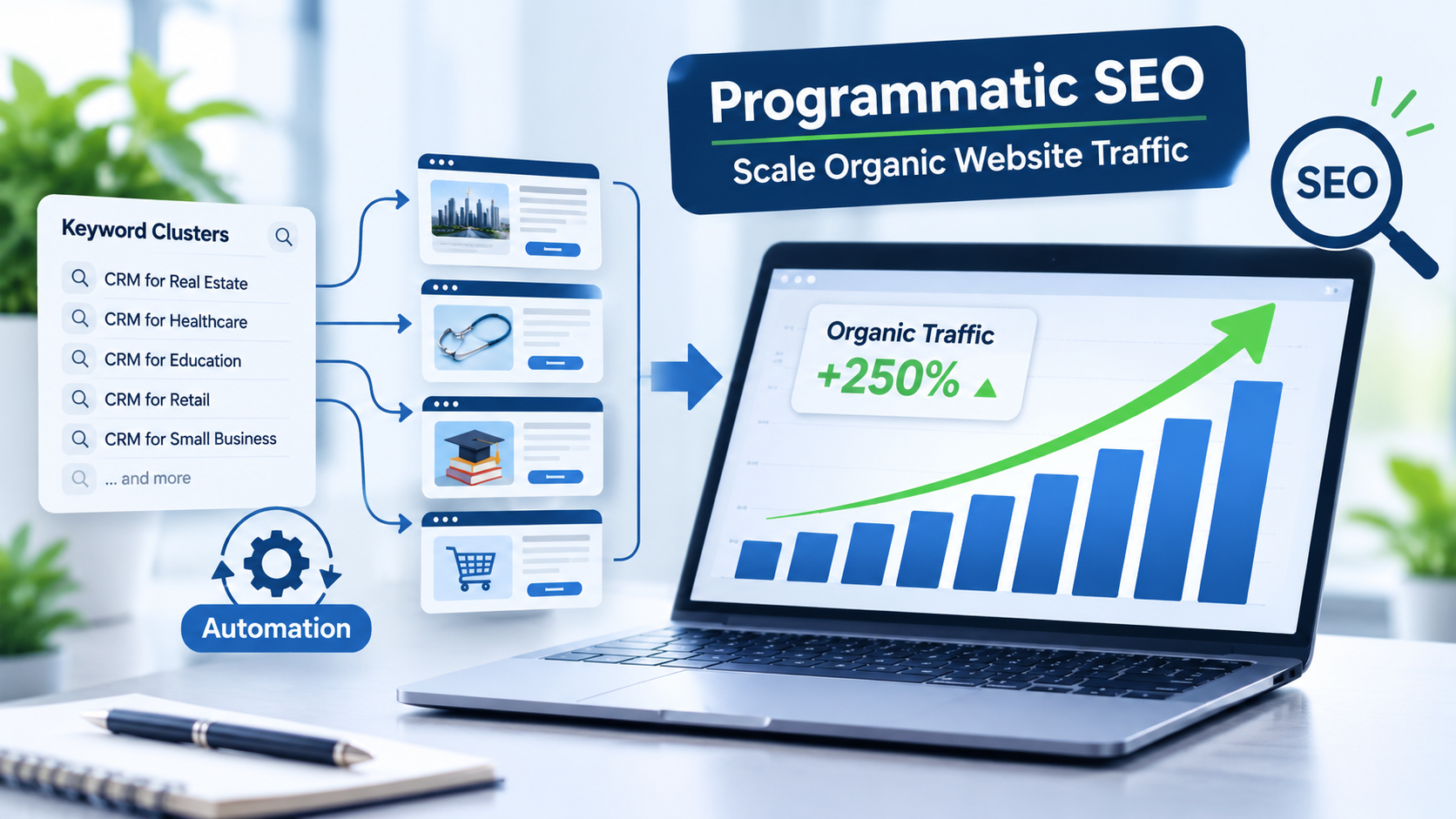
Programmatic SEO is becoming an effective strategy for businesses looking to scale organic website traffic without manually creating every individual landing page. As competition in digital markets increases, businesses need smarter ways to reach potential customers, target relevant search queries, and improve their visibility on search engines. Programmatic SEO makes this possible by combining keyword research, structured data, templates, and automation to generate multiple useful web pages at scale.
Instead of publishing individual pages one at a time, businesses can use programmatic SEO to create targeted pages around specific products, services, locations, industries, or customer needs. When implemented correctly, this approach can help websites reach a wider audience, attract relevant visitors, and create more opportunities for organic growth.
What Is Programmatic SEO?
Programmatic SEO is a search engine optimization strategy that uses structured data and predefined page templates to create multiple search-optimized web pages automatically or semi-automatically.
The main objective is to target large groups of related search queries through individual pages that provide relevant information to users.
For example, a travel website might create separate pages for:
-
Best hotels in Delhi
-
Best hotels in Mumbai
-
Best hotels in Bangalore
-
Best hotels in Jaipur
Rather than manually designing every page, the website uses a common template and location-specific information to generate individual landing pages.
Similarly, a software company can create pages targeting different industries, business sizes, use cases, or software comparisons.
This approach allows businesses to expand their search presence while maintaining a consistent website structure.
How Does Programmatic SEO Work?
Programmatic SEO works by combining keyword research, structured information, content templates, and technical SEO practices.
The process generally involves the following steps.
1. Identify High-Intent Keyword Opportunities
The first step is identifying keyword groups that potential customers regularly search for.
Businesses should look beyond broad keywords and focus on specific search queries that demonstrate user intent.
For example, instead of targeting only "CRM software," a company could target:
-
CRM software for real estate businesses
-
CRM software for small businesses
-
CRM software for educational institutions
-
CRM software for marketing agencies
-
CRM software for sales teams
These specific searches allow businesses to create more relevant pages for different audiences.
Keyword research tools can help identify search demand, competition, related queries, and potential opportunities.
2. Organize Structured Data
Once keyword opportunities are identified, businesses need structured data to support their pages.
Structured data refers to organized information stored in databases, spreadsheets, or content management systems.
For example, an e-commerce website might maintain information about product names, categories, prices, features, and locations.
A service-based business could organize information about its services, industries, locations, pricing models, and customer requirements.
This information becomes the foundation for generating individual pages.
3. Create Reusable Page Templates
Page templates make programmatic SEO scalable.
Businesses can design a standard landing page structure that includes:
-
SEO title and meta description
-
Page heading
-
Introduction
-
Relevant product or service information
-
Features and benefits
-
Frequently asked questions
-
Internal links
-
Call-to-action section
The template remains consistent, while the information changes depending on the target keyword or audience.
However, businesses should ensure that every generated page provides meaningful and unique value rather than simply replacing a few keywords.
4. Generate and Publish Optimized Pages
After preparing the data and templates, businesses can use their website technology or content management system to generate multiple landing pages.
Each page should have a clear purpose and target a relevant search query.
For example, a digital marketing agency could publish separate pages for SEO services across different industries, provided each page includes genuinely relevant industry-specific information.
Before publishing, businesses should review page quality, formatting, keyword placement, and technical SEO elements.
5. Monitor Performance and Improve Pages
Publishing pages is not the final step.
Businesses need to monitor their performance using tools such as Google Search Console and Google Analytics.
Important metrics include:
-
Organic clicks
-
Search impressions
-
Click-through rate
-
Average search position
-
Organic conversions
-
Engagement
-
Indexed pages
By reviewing these metrics, businesses can identify successful pages, improve underperforming content, and remove or consolidate pages that provide little value.
Key Benefits of Programmatic SEO for Businesses
Programmatic SEO offers several advantages for businesses that want to increase their online visibility and attract relevant website visitors.
1. Scalable Organic Traffic Growth
One of the biggest advantages of programmatic SEO is its ability to target hundreds or thousands of relevant search queries through structured landing pages.
Businesses do not need to create every page entirely from scratch. Reusable templates and structured data make the publishing process more efficient.
This creates opportunities to reach audiences searching for specific products, services, locations, and solutions.
2. Improved Keyword Coverage
Traditional SEO strategies often focus on a limited number of primary keywords.
Programmatic SEO allows businesses to target broader groups of long-tail keywords.
For example, a company selling accounting software can target different searches related to industries, business sizes, and accounting requirements.
This helps businesses appear in more relevant search results and reach users with specific needs.
3. Better Opportunities for Lead Generation
Not all website visitors have the same requirements.
Programmatic SEO allows businesses to create pages for different customer segments and search intentions.
For example, a CRM provider can develop separate landing pages for real estate companies, educational institutions, healthcare organizations, and retail businesses.
When visitors find information that directly addresses their requirements, they have a clearer path toward contacting the business or exploring its services.
4. More Efficient Content Production
Creating individual landing pages manually can consume significant time and resources.
Programmatic SEO reduces repetitive work through reusable templates and automated content generation.
Marketing teams can focus more on keyword research, content quality, technical improvements, and performance analysis.
5. Stronger Website Search Visibility
A well-organized programmatic SEO strategy can expand a website's presence across different search categories.
By publishing useful pages that answer specific queries, businesses can build topical relevance and improve their opportunities to attract organic search traffic.
However, simply increasing the number of pages does not guarantee better rankings. Quality and relevance remain essential.
Common Use Cases of Programmatic SEO
Programmatic SEO can be applied across different industries and business models.
E-commerce Websites
E-commerce platforms can create optimized pages for product categories, brands, product specifications, and shopping requirements.
For example:
-
Running shoes for men
-
Running shoes for women
-
Affordable running shoes
-
Running shoes for beginners
These pages can help customers discover relevant products through specific searches.
Travel and Hospitality Businesses
Travel websites can generate pages targeting destinations, accommodation types, travel experiences, and local attractions.
Examples include hotels in different cities, weekend destinations, and family-friendly travel options.
SaaS and Technology Companies
Software companies can use programmatic SEO to target industry-specific solutions, product features, integrations, and use cases.
For example:
-
CRM for real estate businesses
-
CRM for small businesses
-
CRM for marketing agencies
-
CRM for financial services
This strategy helps software providers reach potential customers looking for specialized solutions.
Local Service Businesses
Businesses operating across multiple locations can create location-specific landing pages.
For example, a digital marketing agency may target SEO services in different cities.
However, every location page should provide genuine local relevance, accurate business information, and useful details rather than duplicate content with only city names changed.
Job and Recruitment Platforms
Recruitment websites can create pages based on job roles, industries, skills, locations, and experience levels.
Examples include digital marketing jobs in Delhi, finance jobs for freshers, and remote customer support positions.
These pages can connect job seekers with opportunities matching their search requirements.
Programmatic SEO vs Traditional SEO
Both approaches help websites improve organic search visibility, but their execution methods differ.
|
Feature |
Traditional SEO |
Programmatic SEO |
|---|---|---|
|
Content creation |
Mostly manual |
Template-based and data-driven |
|
Page production |
Individual pages |
Multiple scalable pages |
|
Keyword targeting |
Selected keywords |
Large keyword groups |
|
Data usage |
Varies by project |
Structured data is central |
|
Scalability |
Resource-intensive |
More scalable |
|
Best suited for |
Focused content strategies |
Large websites and repeatable search patterns |
Businesses do not necessarily need to choose one approach over the other. Combining traditional SEO with programmatic SEO can create a more comprehensive search strategy.
Common Programmatic SEO Mistakes Businesses Should Avoid
Although programmatic SEO offers significant growth opportunities, poor implementation can negatively affect website performance.
1. Publishing Thin or Duplicate Content
Creating hundreds of pages with nearly identical information provides little value to users.
Every page should contain useful, relevant, and sufficiently differentiated information.
2. Targeting Irrelevant Keywords
Businesses sometimes focus on generating a large number of pages without checking whether the targeted keywords match their products, services, or audience.
Keyword relevance should always come before page quantity.
3. Ignoring Search Intent
A page should answer the actual question or requirement behind a search query.
For example, someone searching for CRM pricing expects pricing-related information, not a general introduction to CRM software.
Understanding search intent helps businesses create more useful landing pages.
4. Overlooking Technical SEO
Large numbers of generated pages can create technical challenges.
Businesses should pay attention to:
-
Website loading speed
-
Mobile responsiveness
-
XML sitemaps
-
Internal linking
-
Canonical tags
-
Crawlability
-
Indexing issues
-
URL structure
A technically optimized website makes it easier for search engines to discover and understand its pages.
5. Publishing Without Quality Checks
Automated publishing without human review can introduce inaccurate information, broken links, repetitive content, and formatting problems.
Businesses should establish a quality-control process before publishing pages at scale.
Best Practices for Building a Successful Programmatic SEO Strategy
To achieve sustainable organic growth, businesses should follow a structured approach.
Start with a focused keyword group: Begin with one relevant keyword category instead of generating thousands of pages immediately.
Prioritize useful content: Every landing page should answer a specific search query and provide information that users can act on.
Use reliable data sources: Ensure that product details, business information, prices, and location-specific content are accurate and regularly updated.
Create logical internal links: Connect related pages to help visitors navigate the website and allow search engines to discover relevant content.
Optimize for mobile users: Make sure landing pages work smoothly across smartphones, tablets, and desktop devices.
Track SEO performance: Review organic traffic, keyword rankings, indexing, and conversions to understand what is working.
Expand gradually: Test a smaller group of pages, evaluate their performance, and scale the strategy based on actual results.
How AI Is Changing Programmatic SEO
Artificial intelligence is making programmatic SEO workflows more efficient by supporting keyword clustering, content planning, data analysis, and content generation.
AI-powered tools can help businesses identify keyword patterns, organize large datasets, create initial content drafts, and discover optimization opportunities.
For example, an AI-assisted SEO workflow can analyze a group of related search queries and suggest how they should be organized into different landing pages.
However, AI-generated content should not be published without review. Businesses must verify facts, improve relevance, and ensure that each page offers genuine value.
The most effective approach combines automation with human expertise, strategic planning, and editorial quality control.
Conclusion
Programmatic SEO provides businesses with an opportunity to expand their organic search presence through structured data, reusable templates, and scalable content strategies.
From e-commerce platforms and SaaS companies to travel websites and local service providers, businesses can use this approach to target specific search queries and reach audiences with different requirements.
However, successful implementation depends on more than publishing a large number of pages. Keyword relevance, useful content, technical SEO, search intent, and continuous performance monitoring are essential.
By combining programmatic SEO with a strong traditional SEO strategy, businesses can build a scalable foundation for long-term organic website traffic and sustainable digital growth.
Frequently Asked Questions (FAQs)
1. What is programmatic SEO?
Programmatic SEO is an SEO strategy that uses structured data and reusable templates to create multiple optimized web pages targeting related search queries.
2. How does programmatic SEO increase organic website traffic?
It helps businesses target a larger range of relevant keywords through dedicated landing pages, increasing opportunities to appear in search results and attract organic visitors.
3. Is programmatic SEO suitable for small businesses?
Yes. Small businesses can use programmatic SEO when they have repeatable content opportunities, such as multiple services, products, customer segments, or locations.
4. Does programmatic SEO require coding knowledge?
Not always. Some content management systems and SEO platforms offer automation features. However, technical knowledge can be helpful when managing large websites and complex datasets.
5. Can programmatic SEO negatively affect Google rankings?
Yes, if implemented poorly. Publishing large numbers of low-quality, repetitive, or unhelpful pages can create search quality problems. Each page should offer genuine value to users.
6. How long does programmatic SEO take to show results?
Results vary depending on website authority, competition, technical SEO, content quality, and indexing. Businesses should monitor performance over time rather than expecting immediate traffic growth.