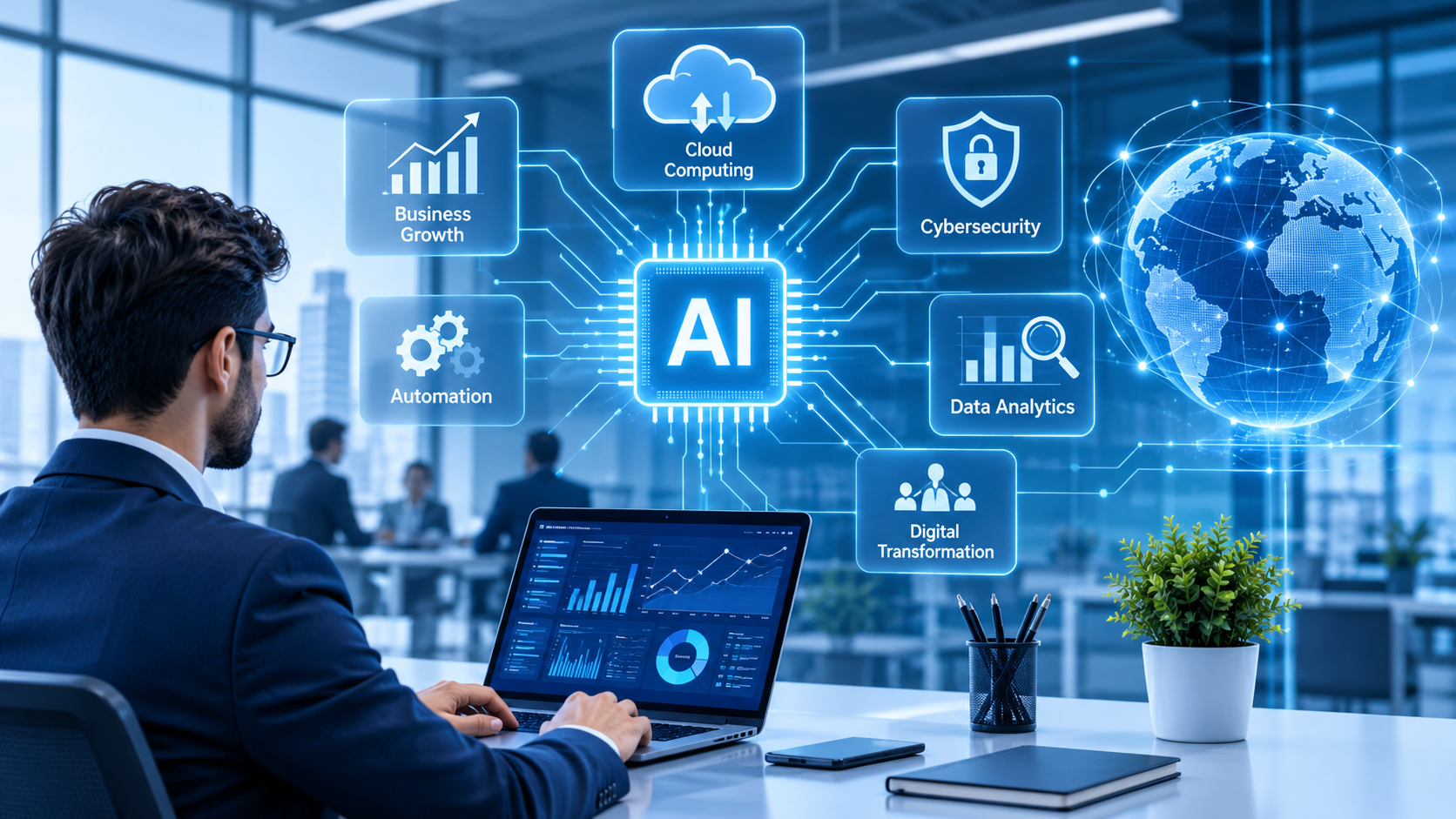

The business world is experiencing a major transformation as emerging technologies continue to change how organisations operate, communicate, serve customers, and compete in the marketplace. From artificial intelligence and automation to blockchain and cloud computing, technological innovation is creating new opportunities for businesses of every size.
Today, companies can no longer depend entirely on traditional business processes to remain competitive. Customers expect faster services, personalised experiences, secure transactions, and seamless digital interactions. At the same time, businesses are looking for smarter ways to reduce operational costs, improve productivity, and make data-driven decisions.
These changing expectations are accelerating the adoption of emerging technologies. Organisations that understand and implement these innovations can improve efficiency, strengthen customer relationships, and build more adaptable business models.
Let's explore the major emerging technologies that are expected to reshape the digital business landscape.
1. Artificial Intelligence and Machine Learning
Artificial intelligence (AI) and machine learning (ML) are among the most influential technologies transforming modern businesses. They allow organisations to analyse large amounts of data, identify patterns, automate repetitive tasks, and generate insights that support better decision-making.
Businesses are increasingly using AI-powered tools for customer support, marketing automation, sales forecasting, fraud detection, and operational management.
Machine learning takes this further by allowing systems to learn from historical data and improve their performance over time.
How AI is transforming businesses:
-
Automating repetitive administrative and operational tasks.
-
Providing personalised product and service recommendations.
-
Improving customer support through intelligent chatbots.
-
Predicting customer behaviour and purchasing patterns.
-
Supporting faster business decisions through data analysis.
Generative AI is also changing content creation, software development, research, and internal business communication. Companies that adopt AI responsibly can improve productivity while allowing employees to focus on strategic and creative activities.
2. Internet of Things (IoT)
The Internet of Things (IoT) refers to a network of connected physical devices that collect and exchange information through the internet. These devices include sensors, smart machines, wearable technology, connected vehicles, and industrial equipment.
IoT is helping businesses monitor operations in real time and make decisions based on accurate information.
For example, manufacturing companies can use connected sensors to monitor equipment performance and identify potential maintenance issues before machinery breaks down. Retail businesses can use smart inventory systems to track stock levels and improve supply chain management.
Business applications of IoT include:
-
Real-time inventory monitoring.
-
Predictive maintenance in manufacturing.
-
Smart energy management.
-
Connected logistics and fleet tracking.
-
Improved workplace safety and operational monitoring.
As IoT adoption grows, businesses can expect better visibility, reduced downtime, and more efficient resource management.
3. Blockchain Technology
Blockchain technology is transforming how businesses manage transactions, share information, and maintain digital records. It is a distributed digital ledger that records transactions across multiple systems, making unauthorised changes more difficult.
Although blockchain is widely associated with cryptocurrencies, its business applications extend far beyond digital currencies.
Organisations can use blockchain to improve transparency, strengthen transaction verification, and create more reliable digital records.
Key business applications include:
-
Secure digital transactions.
-
Supply chain transparency.
-
Digital identity verification.
-
Smart contracts and automated agreements.
-
Improved tracking of goods and assets.
For example, supply chain companies can use blockchain-based systems to record the movement of products from manufacturers to distributors and retailers. This can help improve traceability and reduce opportunities for record manipulation.
However, successful adoption requires careful consideration of implementation costs, scalability, regulations, and integration with existing systems.
4. Cloud Computing and Edge Computing
Cloud computing has changed how businesses store, manage, and access digital resources. Instead of depending entirely on physical servers and local infrastructure, organisations can use cloud-based platforms to access computing power, applications, and storage over the internet.
Cloud technology supports remote collaboration, flexible working environments, business continuity, and scalable operations.
Edge computing complements cloud infrastructure by processing data closer to where it is generated. This reduces the need to send every piece of information to a central cloud server.
Benefits for digital businesses:
-
Flexible infrastructure that can scale with business growth.
-
Reduced dependence on physical IT infrastructure.
-
Improved collaboration across remote teams.
-
Faster processing for time-sensitive applications.
-
Better support for connected devices and real-time operations.
Together, cloud and edge computing are creating more flexible digital infrastructure for modern enterprises.
5. Robotic Process Automation (RPA)
Robotic Process Automation uses software bots to perform repetitive, rule-based business activities. It allows organisations to automate tasks that would otherwise require manual effort.
RPA is particularly useful for processes involving structured information, multiple applications, and recurring administrative work.
For example, businesses can automate invoice processing, employee onboarding documentation, data entry, report generation, and customer information updates.
How RPA benefits organisations:
-
Reduces manual workload.
-
Minimises human errors in repetitive processes.
-
Improves processing speed.
-
Supports consistent business operations.
-
Allows employees to focus on higher-value responsibilities.
When combined with artificial intelligence, automation can also handle more complex workflows involving document understanding, data classification, and decision support.
6. Augmented Reality (AR) and Virtual Reality (VR)
Augmented Reality and Virtual Reality are changing how businesses interact with customers, train employees, and present products.
AR adds digital elements to the real-world environment, while VR creates an immersive virtual environment that users can explore through specialised devices.
These technologies are finding applications across retail, real estate, healthcare, education, manufacturing, and entertainment.
Practical business applications include:
-
Virtual product demonstrations.
-
Interactive shopping experiences.
-
Employee training simulations.
-
Virtual property tours.
-
Remote product visualisation and design.
For example, furniture retailers can use AR applications to help customers visualise how products will look in their homes before purchasing. Similarly, companies can use VR simulations to train employees in environments that would otherwise be expensive or difficult to recreate.
7. Cybersecurity and Zero-Trust Architecture
As businesses become increasingly dependent on digital systems, cybersecurity has become a critical part of digital transformation.
Cyberattacks, data breaches, phishing attempts, and unauthorised access can affect business operations, customer trust, and financial stability.
Modern cybersecurity strategies are moving beyond traditional perimeter-based security. One important approach is Zero-Trust Architecture, which follows the principle of never automatically trusting a user or device simply because it is inside a network.
Important cybersecurity technologies include:
-
Multi-factor authentication.
-
AI-powered threat detection.
-
Identity and access management.
-
Data encryption.
-
Zero-trust security frameworks.
-
Continuous network monitoring.
Businesses need to treat cybersecurity as an ongoing investment rather than a one-time technical upgrade.
8. 5G and Next-Generation Connectivity
Next-generation connectivity is enabling businesses to develop faster and more responsive digital services. 5G technology offers high-speed wireless connectivity, lower latency, and support for a large number of connected devices.
These capabilities are particularly useful for industries that depend on real-time communication and connected infrastructure.
Potential business applications include:
-
Smart manufacturing systems.
-
Connected transportation.
-
Remote monitoring and operations.
-
Real-time data communication.
-
Advanced IoT applications.
-
Cloud-based collaboration.
As connectivity infrastructure continues to develop, businesses will have more opportunities to introduce innovative digital services and improve operational efficiency.
9. Big Data Analytics and Predictive Analytics
Data has become one of the most valuable resources for modern organisations. Businesses generate information through websites, applications, customer interactions, transactions, and operational systems.
Big Data Analytics helps organisations process and analyse large datasets to identify trends, understand customer behaviour, and improve business strategies.
Predictive analytics uses historical data, statistical techniques, and machine learning models to estimate possible future outcomes.
How businesses use data analytics:
-
Understanding customer preferences.
-
Forecasting sales and market demand.
-
Identifying operational inefficiencies.
-
Improving marketing campaigns.
-
Predicting customer churn.
-
Supporting financial planning.
With better analytics capabilities, businesses can move from reactive decision-making towards more informed and proactive strategies.
10. Digital Twins
Digital twin technology involves creating a virtual representation of a physical object, system, or process. It uses real-world data to reflect the condition and performance of its physical counterpart.
Businesses can use digital twins to simulate different scenarios, monitor equipment, and identify potential problems without directly affecting physical operations.
For example, manufacturing companies can create digital models of production equipment to test operational changes and improve performance.
Digital twin applications include:
-
Manufacturing process optimisation.
-
Infrastructure monitoring.
-
Product development and testing.
-
Equipment performance analysis.
-
Predictive maintenance.
Digital twins can help businesses make more informed decisions while reducing the risks and costs associated with physical testing.
How Emerging Technologies Will Impact Business Growth
The adoption of emerging technologies is not simply about introducing new software or upgrading existing systems. It is about changing how businesses create value, serve customers, and manage operations.
Here are some major ways these innovations will influence business growth.
1. Improved Operational Efficiency
Automation, AI, and connected systems can reduce repetitive work and improve productivity. Businesses can complete tasks faster while making better use of their workforce and resources.
2. Better Customer Experiences
AI-powered recommendations, intelligent chatbots, and personalised digital platforms allow companies to understand customer requirements and provide more relevant services.
3. Faster and Smarter Decision-Making
Advanced analytics helps organisations convert business data into actionable insights. Leaders can identify opportunities, understand risks, and make decisions based on measurable information.
4. New Business Models
Emerging technologies are creating opportunities for subscription services, digital marketplaces, AI-powered products, and technology-based service businesses.
5. Stronger Business Competitiveness
Companies that embrace digital innovation can respond more effectively to changing customer expectations, market conditions, and industry developments.
Challenges Businesses Must Consider
Although emerging technologies offer significant opportunities, implementing them also comes with challenges.
Some common barriers include:
-
Implementation costs: Advanced technology may require substantial initial investment.
-
Data privacy: Businesses must protect customer and organisational information.
-
Cybersecurity risks: Greater digital connectivity can introduce additional security vulnerabilities.
-
Skill shortages: Employees may require specialised training to work with new technologies.
-
Integration difficulties: New systems may not always work smoothly with existing business infrastructure.
-
Resistance to change: Employees and management may need time to adapt to new processes.
To overcome these challenges, organisations should develop a clear technology strategy, invest in employee training, and evaluate the long-term value of each technology before implementation.
How Businesses Can Prepare for the Future of Digital Transformation
Businesses do not need to adopt every emerging technology immediately. Instead, they should identify innovations that align with their objectives and operational requirements.
A practical approach includes:
-
Identify business requirements: Understand existing operational challenges and areas where technology can add value.
-
Prioritise relevant technologies: Select solutions that address specific business needs.
-
Invest in digital infrastructure: Build reliable systems that support future technology adoption.
-
Develop employee capabilities: Provide training to help teams adapt to changing digital workflows.
-
Strengthen cybersecurity: Establish effective data protection and security practices.
-
Monitor performance: Evaluate technology investments through productivity, customer satisfaction, and business growth metrics.
A well-planned approach allows businesses to adopt innovation gradually while maintaining operational stability.
Conclusion
Emerging technologies are reshaping the digital business landscape and creating new possibilities for organisations across industries. Artificial intelligence, blockchain, IoT, cloud computing, automation, and advanced analytics are changing how companies operate, interact with customers, and make strategic decisions.
However, successful digital transformation requires more than adopting the latest technology. Businesses must understand their requirements, invest in the right solutions, develop employee skills, and maintain strong security practices.
Organisations that approach technological innovation strategically will be better positioned to adapt to market changes, improve efficiency, and discover new opportunities for growth.
The future of digital business will belong to companies that are willing to innovate, adapt, and use technology to create meaningful value.
3. Frequently Asked Questions (FAQs)
1. What are emerging technologies in digital business?
Emerging technologies are new or rapidly developing innovations that transform business operations. Examples include artificial intelligence, blockchain, IoT, cloud computing, robotics, and augmented reality.
2. How does artificial intelligence help businesses?
AI helps businesses automate repetitive tasks, analyse customer data, improve customer service, forecast demand, and make informed decisions.
3. Why is digital transformation important for modern businesses?
Digital transformation helps organisations improve operational efficiency, enhance customer experiences, reduce manual processes, and remain competitive.
4. Which emerging technologies will have the biggest business impact?
Artificial intelligence, machine learning, cloud computing, cybersecurity, automation, IoT, and data analytics are among the technologies expected to have a significant impact.
5. How can small businesses adopt emerging technologies?
Small businesses can begin with affordable cloud platforms, AI-powered tools, CRM software, marketing automation, and cybersecurity solutions before investing in more advanced technologies.
6. What are the biggest challenges of adopting emerging technologies?
Common challenges include implementation costs, cybersecurity threats, data privacy concerns, employee training, and integration with existing systems.